MCQ
An $\alpha$-particle after passing through a potential difference of $V$ volts collides with a nucleus. If the atomic number of the nucleus is $Z$, then the distance of closest approach of $\alpha$-particle to the nucleus will be
  • $14.4 \frac{Z}{V} Å$
  • B
    $14.4 \frac{ Z }{ V } m$
  • C
    $14.4 \frac{ Z }{ V } cm$
  • D
    $1.44 \times 10^{-15} m$

Answer

Correct option: A.
$14.4 \frac{Z}{V} Å$
(A) $14.4 \frac{Z}{V} Å$
For closest approach, Initial kinetic energy of $\alpha$-particle = Potential energy of $\alpha$-particle at closest approach
$
\begin{array}{l}
(2 e) V=\frac{1}{4 \pi \varepsilon_0} \frac{(2 e)(Ze)}{d} \\
d=\frac{1}{4 \pi \varepsilon_0} \frac{Ze}{V}=\left(9 \times 10^9\right) \frac{Z}{V}\left(1.6 \times 10^{-19}\right)=14.4 \frac{Z}{V} Å
\end{array}
$

Need a full question paper?

Generate a complete, print-ready paper with questions like this in minutes — across 16+ boards, with answer keys.

Start Generating Free

Similar questions

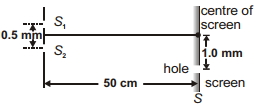
In Young's double slit experiment shown in figure. $S_1$ and $S_2$ are coherent sources and $S$ is the screen having a hole at a point $1.0 \,mm$ away from the central line. White light $(400$ to $700\, nm )$ is sent through the slits. Which wavelength passing through the hole has strong intensity is ............. $nm$
The linear mass density of a thin rod $A B$ of length $L$ varies from $A$ to $B$ as $\lambda( x )=\lambda_{0}\left(1+\frac{ x }{ L }\right),$ where $x$ is the distance from A. If $M$ is the mass of the rod then its moment of inertia about an axis passing through $A$ and perpendicular to the rod is$......ML^{2}$
Fusion reaction takes place at high temperature because 
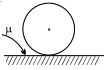
The torque acting on a body about centre of mass due to normal reaction
The angle of dip at a place is $60°$. At this place the total intensity of earth's magnetic field is $0.64 $ $units$. The horizontal intensity of earth's magnetic field at this place is......$ units$
Assertion $(A):$ If there is not external torque on a body about its centre of mass, then the velocity of the centre of mass remains constant.

Reason $(R):$ The linear momentum of an isolated system remains constant.

According to the kinetic theory of gases the $r.m.s.$ velocity of gas molecules is directly proportional to
$A$ disc of radius $r$ is rotating about its centre with an angular speed $\omega_0$. It is gently placed on a rough horizontal surface. After what time it will be in pure rolling ?
The frequency of a light wave in a material is $2 \times 10^{14}\,\, Hz$ and wavelength is $5000 \,\mathring A$. The refractive index of material will be 
The average degree of freedom per molecule of a gas is $6$. The gas performs $25\  J$ work, while expanding at constant pressure. The heat absorbed by the gas is   .... $J$