MCQ
An electric filament bulb can be worked from:
  • A
    DC supply only.
  • B
    AC supply only.
  • C
    Battery supply only.
  • All above.

Answer

Correct option: D.
All above.
An electric filament bulb can be worked from

Need a full question paper?

Generate a complete, print-ready paper with questions like this in minutes — across 16+ boards, with answer keys.

Start Generating Free

Similar questions

A galaxy is observed to be moving with a velocity of $8600 km-sec^{-{1}}$. If it is at a distance of $430$ million light year from us, Hubble constant and corresponding age of the universe are respectively
Capacitance of a capacitor made by a thin metal foil is 2μF. If the foil is folded with paper of thickness 0.15 mm, dielectric constant of paper is 2.5 and width of paper is 400 mm , then length of foil will be
An electron is traveling along the $x -$ direction. It encounters a magnetic field in the $y -$ direction. Its subsequent motion will be:
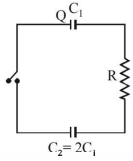
Two capacitors $C_1$ and $C_2=$ $2 C _1$ are connected in a circuit with a switch between them as shown in the figure.Initially the switch is open and $C _1$ holds charge $Q$. The switch is closed. At steady state, the charge on each capacitor will be
The radius of a charged metal sphere $(R)$ is $10\,cm$ and its potential is $300\,V$. Find the charge density on the surface of the sphere
Two point charges $A$ and $B$ of magnitude $+8 \times 10^{-6}\,C$ and $-8 \times 10^{-6}\,C$ respectively are placed at a distance $d$ apart. The electric field at the middle point $O$ between the charges is $6.4 \times 10^{4}\,NC ^{-1}$. The distance ' $d$ ' between the point charges $A$ and $B$ is..............$m$
In a $YDSE$ experiment if $a$ slab whose refractive index can be varied is placed in front of one of the slits then the variation of resultant intensity at mid-point of screen with $‘\mu ’$ will be best represented by $(\mu \geq 1)$.[Assume slits of equal width and there is no absorption by slab]
Absolute refractive indices of glass and water are $\frac{2}{3}$ and $\frac{4}{3}$ . The ratio of velocity of light in glass and water will be
The wavelength of the energy emitted when electron come from fourth orbit to second orbit in hydrogen is $20.397\,cm$. The wavelength of energy for the same transition in $H{e^ + }$ is .......... $c{m^{ - 1}}$
The energy required to remove an electron in a hydrogen atom from $n = 10$ state is