MCQ
The energy required to remove an electron in a hydrogen atom from $n = 10$ state is
  • A
    $13.6 eV$
  • B
    $1.36 eV$
  • $0.136 eV$
  • D
    $0.0136 eV$

Answer

Correct option: C.
$0.136 eV$
c
(c) Energy required$=\frac{13.6}{{{n}^{2}}}=\frac{13.6}{{{10}^{2}}}=0.136\,eV$

Need a full question paper?

Generate a complete, print-ready paper with questions like this in minutes — across 16+ boards, with answer keys.
Start Generating Free

Similar questions

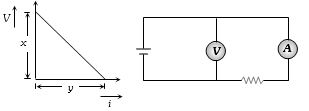
In an experiment, a graph was plotted of the potential difference $V$ between the terminals of a cell against the circuit current $i$ by varying load rheostat. Internal conductance of the cell is given by
If a full wave rectifier circuit is operating from 50 Hz mains, the fundamental frequency in the ripple will be
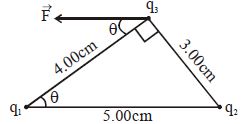
Three charges are placed as shown in figure. The magnitude of $q_1$ is $2.00\, \mu C$, but its sign and the value of the charge $q_2$ are not known. Charge $q_3$ is $+4.00\, \mu C$, and the net force on $q_3$ is entirely in the negative $x-$ direction. The magnitude of $q_2$ is
A particle of mass $200 \,MeV / c ^{2}$ collides with a hydrogen atom at rest. Soon after the collision the particle comes to rest, and the atom recoils and goes to its first excited state. The initial kinetic energy of the particle (in $eV$ ) is $\frac{ N }{4} .$ The value of $N$ is :

(Given the mass of the hydrogen atom to be $\left.1\, GeV / c ^{2}\right)$

A metallic ring with a small cut is held horizontally and a magnet is allowed to fall  vertically through the ring then the acceleration of the metallic ring is :
A coil of 100 turns and area 5 square centimetre is placed in a magnetic field B = 0.2 T. The normal to the plane of the coil makes an angle of 60° with the direction of the magnetic field. The magnetic flux linked with the coil is
Three capacitors of 2.0, 3.0 and 6.0 μF are connected in series to a 10 V source. The charge on the 3.0 μF capacitor is
A convex lens and a concave lens, each having same focal length of $25\,\, cm,$ are put in contact to form a combination of lenses. The power in diopters of the combination is 
A charged particle initially at rest at $O$,when released follows a trajectory as shown alongside. Such a trajectory is possible in the presence of
Which of these is a fusion reaction