An electric wire is connected across a cell of $e.m.f.$ The current $I$ is measured by an ammeter of resistance $R$. According to ohm's law
Easy


Download our appand get started for free
Experience the future of education. Simply download our apps or reach out to us for more information. Let's shape the future of learning together!No signup needed.*
Similar Questions
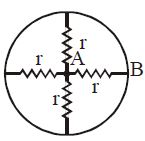
- 1The equivalent resistance betweent point $A$ and $B$View Solution
- 2There is a current of $20$ amperes in a copper wire of ${10^{ - 6}}$ square meter area of cross-section. If the number of free electrons per cubic meter is ${10^{29}}$, then the drift velocity isView Solution
- 3A resistor ${R_1}$ dissipates the power $P$ when connected to a certain generator. If the resistor ${R_2}$ is put in series with ${R_1}$, the power dissipated by ${R_1}$View Solution
- 4Three $60\, W$ light bulbs are mistakenly wired in series and connected to a $120\,V$ power supply. Assume the light bulbs are rated for single connection to $120\,V$. With the mistaken connection, the power dissipated by each bulb is: .................. $W$View Solution
- 5Consider a wire having current $10\,A$ having area of crossection $1\,cm^2$. If number of electrons per unit volume is $9 \times 10^{28}\, m^{-3}$. Find the drift velocity of electronsView Solution
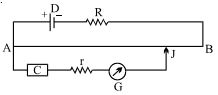
- 6In the given potentiometer circuit, the resistance of the potentiometer wire $AB$ is $R_0$. $C$ is a cell of internal resistance $r$. The galvanometer $G$ does not give zero deflection for any position of the jockey $J$. Which of the following cannot be a reason for this?View Solution
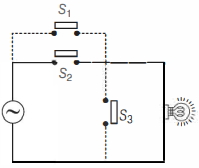
- 7View SolutionConsider the following circuit given below. The bulb will light up, if
- 8We have two wires $A$ and $B$ of same mass and same material. The diameter of the wire $A$ is half of that $B$. If the resistance of wire $A$ is $24\, ohm$ then the resistance of wire $B$ will be ................ $Ohm$View Solution
- 9A battery of $24$ cells, each of emf $1.5\, V$ and internal resistance $2\, \Omega$ is to be connected in order to send the maximum current through a $12 \,\Omega$ resistor. The correct arrangement of cells will beView Solution
- 10In a conductor $4$ coulombs of charge flows for $2$ seconds. The value of electric current will beView Solution