There is a current of $20$ amperes in a copper wire of ${10^{ - 6}}$ square meter area of cross-section. If the number of free electrons per cubic meter is ${10^{29}}$, then the drift velocity is
Easy
Download our app for free and get started
(c) ${v_d} = \frac{i}{{nAe}} = \frac{{20}}{{{{10}^{29}} \times {{10}^{ - 6}} \times 1.6 \times {{10}^{ - 19}}}}$$ = 1.25 \times {10^{ - 3}}\,m/s$

Download our appand get started for free
Experience the future of education. Simply download our apps or reach out to us for more information. Let's shape the future of learning together!No signup needed.*
Similar Questions
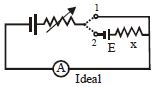
- 1In the circuit shown the variable resistance is so adjusted that the ammeter reading is same in both the position $1$ and $2$ of the key. The reading of ammeter is $2A$. If $E = 20V$, then $x$ is :- ................... $\Omega$View Solution
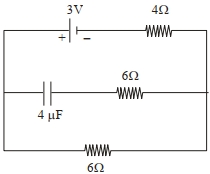
- 2In the network shown below, the charge accumulated in the capacitor in steady state will be ........... $\mu C$View Solution
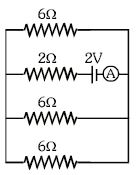
- 3The ammeter reading in the following circuit will be .............. $A$View Solution
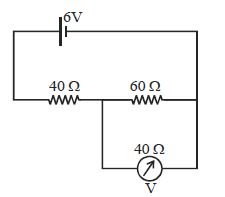
- 4The reading of voltmeter in the circuit shown is ............. $V$View Solution
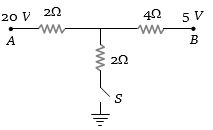
- 5As the switch $S$ is closed in the circuit shown in figure, current passed through it is .................. $A$View Solution
- 6Three resistances of one ohm each are connected in parallel. Such connection is again connected with $\frac{2}{3}\,\Omega $ resistor in series. The resultant resistance will be ........... $\Omega$View Solution
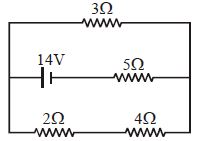
- 7Find out current in $3\,\Omega $ resistance in given circuitView Solution
- 8In a potentiometer wire experiment the $\mathrm{emf}$ of a battery in the primary circuit is $20\,V$ and its internal resistance is $5\,\Omega$ . There is a resistance box in series with the battery and the potentiometer wire, whose resistance can be varied from $120\,\Omega$ to $170\,\Omega$ . Resistance of the potentiometer wire is $75\,\Omega$ . The following potential differences can be measured using this potentiometer.View Solution
- 9A thermocouple of negligible resistance produces an $e.m.f.$ of $40\,\mu V{/^o}C$ in the linear range of temperature. A galvanometer of resistance $10\; ohm$ whose sensitivity is $1\;\mu A/div$, is employed with the thermocouple. The smallest value of temperature difference that can be detected by the system will beView Solution
- 10View SolutionThe resistance of an incandescent lamp is