Question
An electrically maintained tuning fork vibrates with constant frequency and constant amplitude. If the temperature of the surrounding air increases but pressure remains constant, the sound produced will have:
  1. Larger wavelength.
  2. Larger frequency.
  3. Larger velocity.
  4. Larger time period.

Answer

  1. Larger wavelength.
  1. Larger velocity.

Explanation:

The velocity varies with temperature as $\text{v}\propto\sqrt{\text{T}}.$ Therefore, it increases. Since the frequency remains constant, the wavelength will increase as $\lambda\propto\text{v}.$

Need a full question paper?

Generate a complete, print-ready paper with questions like this in minutes — across 16+ boards, with answer keys.

Start Generating Free

Similar questions

Which of the following is not the disadvantage of wire wound resistor?

The ratio of minimum to maximum wavelength in Balmer series is

(a) 5 : 9

(b) 5 : 36

(c) 1 : 4

(d) 3 : 4

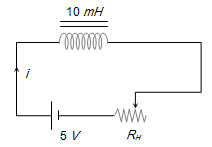
The resistance in the following circuit is increased at a particular instant. At this instant the value of resistance is 10W. The current in the circuit will be now

(a) i = 0.5 A

(b) i > 0.5 A

(c) i < 0.5 A

(d) i = 0

An object is placed at a distance u from a simple microscope of focal length f. The angular magnification obtained depends:
  1. On f but not on u.
  2. On u but not on f.
  3. On f as well as u.
  4. Neither on f nor on u.
In Young's double slit experiment, the interference pattern obtained with white light will be:
Tritium is an isotope of hydrogen whose nucleus Triton contains 2 neutrons and 1 proton. Free neutrons decay into $\text{p}+\overline{\text{e}}+\overline{\text{v}}$. If one of the neutrons in Triton decays, it would transform into He3 nucleus. This does not happen. This is because:

The electric potential at the surface of an atomic nucleus (Z = 50) of radius 9.0 ×   cm is

(a) 80 volts

(b) 8  volts

(c) 9 volts

(d) 9  volts

An electron is projected with uniform velocity along the axis of a current carrying long solenoid. Which of the following is true?

The ratio of thickness of plates of two transparent mediums A and B is 6 : 4.  If light takes equal time in passing through them, then refractive index of B with respect to A will be

(a) 1.4

(b) 1.5

(c) 1.75

(d) 1.33

Which of the following could not produce a virtual image

(a) Plane mirror

(b) Convex mirror

(c) Concave mirror

(d) All the above can produce a virtual image