- AThe central fringe bright and alternate bright and dark fringes.
- BThe central fringe achromatic and coloured fringes for small path difference.
- CThe central fringe dark
- DThe central fringe coloured
Explanation:
If white light is used a white centre fringe is observed, but all the other fringes have coloured edges, the blue edge being nearer the centre. Eventually the fringes overlap and a uniform white light is produced.
Generate a complete, print-ready paper with questions like this in minutes — across 16+ boards, with answer keys.
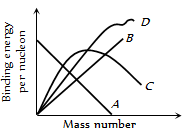
Binding energy per nucleon plot against the mass number for stable nuclei is shown in the figure. Which curve is correct

|
(a) A |
(b) B |
(c) C |
(d) D |
Mass of earth has been determined through
|
(a) Use of Kepler's |
|
(b) Sampling the density of earth's crust and using R |
|
(c) Cavendish's determination of G and using R and 'g' at the surface |
|
(d) Use of periods of satellites at different heights above earth's surface |
A convex lens of power + 6D is placed in contact with a concave lens of power – 4D. What is the nature and focal length of the combination
|
(a) Concave, 25 cm |
(b) Convex, 50 cm |
(c) Concave, 20 cm |
(d) Convex, 100 cm |
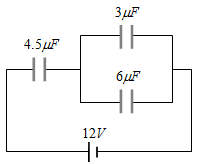
In the circuit shown in the figure, the potential difference across the 4.5mF capacitor is

|
(a) |
(b) 4 volts |
(c) 6 volts |
(d) 8 volts |
If two lenses of +5 diopters are mounted at some distance apart, the equivalent power will always be negative if the distance is
|
(a) Greater than 40 cm |
(b) Equal to 40 cm |
|
(c) Equal to 10 cm |
(d) Less than 10 cm |
If energy of K-shell electron is – 40000 eV and If 60000 V potential is applied at coolidge tube then which of the following X-ray will get form
|
(a) Continuous |
|
(b) White X-rays |
|
(c) Continuous and all series of characteristic |
|
(d) None of these |