MCQ
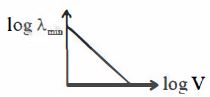
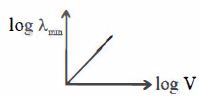
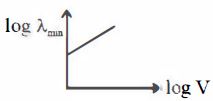
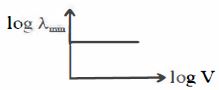
An electron beam is accelerated by a potential difference $V$ to hit a metallic target to produce $X-$rays. It produces continuous as well as characteristic $X-$ rays.If $λ_{min}$ is the smallest possible wavelength of $X-$ray in the spectrum, the variation of log $log$ $λ_{min}$ with $log\ V$ is correctly represented in 

  • B

  • C

  • D

Answer

Correct option: A.

a
In $\mathrm{X}$ -ray tube, $\lambda_{\min }=\frac{h c}{e V}$

$\ln \lambda_{\min }=\ln \left(\frac{h c}{e}\right)-\ln V$

Clearly, log $\lambda_{\min }$ versus log $V$ graph slope is negative hence option

Need a full question paper?

Generate a complete, print-ready paper with questions like this in minutes — across 16+ boards, with answer keys.

Start Generating Free

Similar questions

A parallel beam of monochromatic light is incident on a narrow rectangular slit of width $1\,mm$. When the diffraction pattern is seen on a screen placed at a distance of $2\,m$. the width of principal maxima is found to be $2.5\,mm$. The wave length of light is-$.............\mathring A$
A current carrying loop is placed in a uniform magnetic field. The torque acting on it does not depend upon
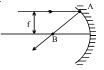
$A$ ray of light is incident on a concave mirror. It is parallel to the principal axis and its height from principal axis is equal to the focal length of the mirror. The ratio of the distance of point $B$ to the distance of the focus from the centre of curvature is ($AB$ is the reflected ray)
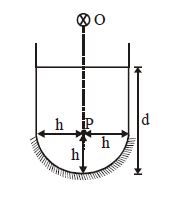
A concave mirror of radius $h$ is placed at the bottom of a tank containing a liquid of refractive index $μ$ upto a depth $d$ . An object $P$ is placed at height $h$ above the bottom of the mirror. Outside the liquid, an observer $O$ views the object and its image in the mirror. The apparent distance between these two will be
The electromagnetic waves travel in a medium at a speed of $2.0 \times 10^{8}\, m / s$. The relative permeability of the medium is $1.0.$ The relative permittivity of the medium will be
Rate of change of torque τ with deflection θ is maximum for a magnet suspended freely in a uniform magnetic field of induction B, when
A loop $ABCDEFA$ of straight edges has six corner points $\mathrm{A}(0,0,0), \mathrm{B}(5,0,0),$$\mathrm{C}(5,5,0) ,\mathrm{D}(0,5,0), \mathrm{E}(0,5,5)$ and $\mathrm{F}(0,0,5) .$ The magnetic field in this region is $\overrightarrow{\mathrm{B}}=(3 \hat{\mathrm{i}}+4 \hat{\mathrm{k}}) \;\mathrm{T}$. The quantity of flux through the loop $\mathrm{ABCDEFA}(\text { in Wb })$ is
The intensity of light from a continuously emitting laser source operating at $638 \,nm$ wavelength is modulated at $1 \,GHz$. The modulation is done by momentarily cutting the intensity off with a frequency of $1 \,GHz$. What is the farthest distance apart two detectors can be placed in the line of the laser light, so that they can see the portions of the same pulse simultaneously?

(Consider the speed of light in air $3 \times 10^{8} \,m / s$ )

In an $A.C.$ circuit, $I_{\text {rms }}$ and $I_{0}$ are related as
An electron in an excited state of $Li ^{2+}$ ion has angular momentum $3 h / 2 \pi$. The de Broglie wavelength of the electron in this state is $p \pi a_0$ (where $a_0$ is the Bohr radius). The value of $p$ is