Question
An electron does not suffer any deflection while passing through a region of uniform magnetic field. What is the direction of the magnetic field?

Answer

Magnetic field and motion of electron should be/parallel/anti parallel.

Need a full question paper?

Generate a complete, print-ready paper with questions like this in minutes — across 16+ boards, with answer keys.
Start Generating Free

Similar questions

Write two differences between charge and mass.
If a spherical mirror is dipped in water, does its focal length change?
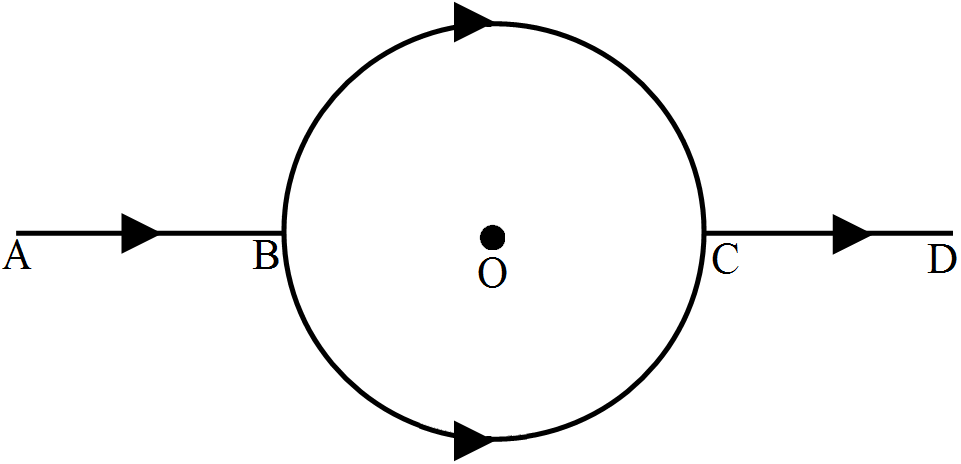
What is the magnetic field at point O due to current carrying wires shown in figure?

Consider the energy density in a solenoid at its centre and that near its ends. Which of the two is greater?
Write any two conditions for total internal reflection.
A converging lens is kept coaxially in contact with a diverging lens – both the lenses being of equal focal lengths. What is the focal length of the combination?
An experimenter measures the length of a rod. In the cases listed, all motions are with respect to the lab and parallel to the length of the rod. In which of the cases the measured length will be minimum?
  1. The rod and the experimenter move with the same speed v in the same direction.
  2. The rod and the experimenter move with the same speed v in opposite directions.
  3. The rod moves at speed v but the experimenter stays at rest.
  4. The rod stays at rest but the experimenter moves with the speed v.
In a series LCR circuit, the voltages across an inductor, a capacitor and a resistor are 30 V, 30 V and 60 V respectively. What is the phase difference between the applied voltage and the current in the circuit?
A capillary tube of radius 0.50mm is dipped vertically in a pot of water. Find the difference between the pressure of the water in the tube 5.0cm below the surface and the atmospheric pressure. Surface tension of water = 0.075N/m.
A current $\text{i}_1=\text{i}_0\sin\omega\text{t}$ passes through a resistor of resistance R. How much thermal energy is produced in one time period? A current $\text{i}_2=-\text{i}_0\sin\omega\text{t}$ passes through the resistor. How much thermal energy is produced in one time period? If i1, and i2 both pass through the resistor simultaneously, how much thermal energy is produced? Is the principle of superposition obeyed in this case?