Question
An electron having charge ‘e’ and mass ‘m’ is moving in a uniform electric field E. Its acceleration will be
|
(a) |
(b) |
(c) |
(d) |
An electron having charge ‘e’ and mass ‘m’ is moving in a uniform electric field E. Its acceleration will be
|
(a) |
(b) |
(c) |
(d) |
(c) 
Generate a complete, print-ready paper with questions like this in minutes — across 16+ boards, with answer keys.
Four resistances are connected in a circuit in the given figure. The electric current flowing through 4 ohm and 6 ohm resistance is respectively
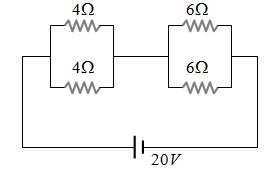
|
(a) 2 amp and 4 amp |
(b) 1 amp and 2 amp |
|
(c) 1 amp and 1 amp |
(d) 2 amp and 2 amp |
An infinite number of identical capacitors each of capacitance 1 μF are connected as in adjoining figure. Then the equivalent capacitance between A and B is
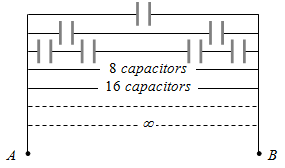
|
(a) 1 μF |
(b) 2 μF |
(c) |
(d) ∞ |
Assertion : Density of all the nuclei is same.
Reason : Radius of nucleus is directly proportional to the cube root of mass number.
|
(a) If both assertion and reason are true and the reason is the correct explanation of the assertion. |
|
(b) If both assertion and reason are true but reason is not the correct explanation of the assertion. |
|
(c) If assertion is true but reason is false. |
|
(d) If the assertion and reason both are false. |
Four wires of equal length and of resistances 10 ohms each are connected in the form of a square. The equivalent resistance between two opposite corners of the square is
|
(a) 10 ohm |
(b) 40 ohm |
(c) 20 ohm |
(d) 10/4 ohm |
AB is a wire of uniform resistance. The galvanometer G shows no current when the length AC = 20cm and CB = 80 cm. The resistance R is equal to

|
(a) 2 Ω |
(b) 8 Ω |
(c) 20 Ω |
(d) 40 Ω |
A soap bubble is given a negative charge, then its radius
|
(a) Decreases |
|
(b) Increases |
|
(c) Remains unchanged |
|
(d) Nothing can be predicted as information is insufficient |
In the given figure, equivalent resistance between A and B will be

|
(a) |
(b) |
(c) |
(d) |


