- AZero, since charge on electron in constant
- B$\frac{\mu_0\text{er}^2}{4\text{R}}\alpha$
- C$\frac{\mu_0\text{er}^2}{4\pi\text{R}}\alpha$
- DNone of these
Explanation:
Using the formulas-
$\text{I}=\frac{\text{e}}{\text{T}}=\frac{\text{e}\omega}{2\pi}$
B at center $=\frac{\mu_0}{2\text{R}}=\frac{\mu_0\text{e}\omega}{4\pi\text{R}}$
$\phi=\text{B}.\pi\text{r}^2=\frac{\mu_0}{4\pi\text{R}}\text{e}\omega\pi\text{r}^2$
$=\frac{\mu_0\text{e}\omega\text{r}^2}{4\text{R}}$
$\text{e}=-\frac{\text{d}\phi}{\text{dt}}=\frac{\mu\text{e}\text{r}^2\alpha}{4\text{R}}$
Generate a complete, print-ready paper with questions like this in minutes — across 16+ boards, with answer keys.
The de-Broglie wavelength of an electron having 80eV of energy is nearly (1eV = 1.6 × 10⁻¹⁹ J, Mass of electron = 9 × 10–31kg Plank’s constant = 6.6 × 10⁻³⁴ J-sec)
|
(a) 140 Å |
(b) 0.14 Å |
(c) 14 Å |
(d) 1.4 Å |
In X-ray tube when the accelerating voltage V is halved, the difference between the wavelength of Ka line and minimum wavelength of continuous X-ray spectrum
|
(a) Remains constant |
(b) Becomes more than two times |
|
(c) Becomes half |
(d) Becomes less than two times |
A glass convex lens ( = 1.5) has a focal length of 8 cm when placed in air. What would be the focal length of the lens when it is immersed in water (
)
|
(a) 2 m |
(b) 4 cm |
(c) 16 cm |
(d) 32 cm |
Which of the following element was discovered by study of Fraunhofer lines
|
(a) Hydrogen |
(b) Oxygen |
(c) Helium |
(d) Ozone |
If a power of 100 W is being supplied across a potential difference of 200 V, current flowing is
|
(a) 2 A |
(b) 0.5 A |
(c) 1 A |
(d) 20 A |
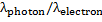
A photon and an electron have equal energy E.
is proportional to
|
(a) |
(b) 1/ |
|
(c) 1/E |
(d) Does not depend upon E |