MCQ
An element A decays into element C by a two step process :
A → B + ${2^{He}}^4$
B → C + ${2^e}^{-}$
Then
  • A and C are isotopes
  • B
    A and C are isobars
  • C
    A and B are isotopes
  • D
    A and B are isobars

Answer

Correct option: A.
A and C are isotopes
(a) A and C are isotopes

Need a full question paper?

Generate a complete, print-ready paper with questions like this in minutes — across 16+ boards, with answer keys.
Start Generating Free

Similar questions

In a biprism experiment, by using light of wavelength 5000 Å, 5 mm wide fringes are obtained on a screen 1.0 m away from the coherent sources. The separation between the two coherent sources is
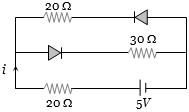
Current in the circuit will be
A cubical block of mass M and edge a slides down a rough inclined plane of inclination $\theta$ with a uniform velocity. The torque of the normal force on the block about its centre has a magnitude:
The magnetic susceptibility of any paramagnetic material changes with absolute temperature $T$ as
A convex lens of power + 6D is placed in contact with a concave lens of power – 4D. What is the nature and focal length of the combination
Length of a hollow tube is 5m, it’s outer diameter is 10 cm and thickness of it’s wall is 5 mm. If resistivity of the material of the tube is $1.7 \times 10^{-8} \Omega \times \mathrm{m}$ then resistance of tube will be 
Work done by an external agent in separating the parallel plate capacitor is
This question has Statement $1$ and Statement $2$. Of the four choices given after the Statements, choose the one that best describes the two Statements.

Statement $1$ : A pure semiconductor has negative temperature coefficient of resistance.

Statement $2$ : On raising the temperature, more charge carriers are released into the conduction band

An ideal transformer has $100$ turns in the primary and $250$ turns in the secondary. The peak value of the $ac$ is $28 \,V$. The r.m.s. secondary voltage is nearest to.....$V$
At a distance $l$ from a uniformly charged long wire, a charged particle is thrown radially outward with a velocity $u$ in the direction perpendicular to the wire. When the particle reaches a distance $2 l$ from the wire, its speed is found to be $\sqrt{2} u$. The magnitude of the velocity, when it is a distance $4 l$ away from the wire is (ignore gravity)