Question
An ideal diode should pass a current freely in one direction and should stop it completely in the opposite direction. Which is closer to ideal-vacuum diode or a p-n junction diode?

Answer

It should be an ideal vacuum diode. When a p-n junction diode is reverse biassed then a small current called reverse current flows across the diode. As the the p‒n junction diode allows some current in reverse biassed condition also so the given diode cannot be a p-n junction diode.

Need a full question paper?

Generate a complete, print-ready paper with questions like this in minutes — across 16+ boards, with answer keys.
Start Generating Free

Similar questions

The length of a rod is exactly 1m when measured at rest. What will be its length when it moves at a speed of:
  1. $3 \times 10^5$m/s.
  2. $3 \times 10^6$m/s.
  3. $3 \times 10^7$m/s.
A circular copper-ring of radius r translates in its plane with a constant velocity v. A uniform magnetic field B exists in the space in a direction perpendicular to the plane of the ring. Consider different pairs of diametrically opposite points on the ring.
  1. Between which pair of points is the emf maximum? What is the value of this maximum emf?
  2. Between which pair of points is the emf minimum? What is the value of this minimum emf?
A 660Hz tuning fork sets up vibration in a string clamped at both ends. The wave speed for a transverse wave on this string is 220m/s and the string vibrates in three loops.
  1. Find the length of the string.
  2. If the maximum amplitude of a particle is 0.5cm, write a suitable equation describing the motion.
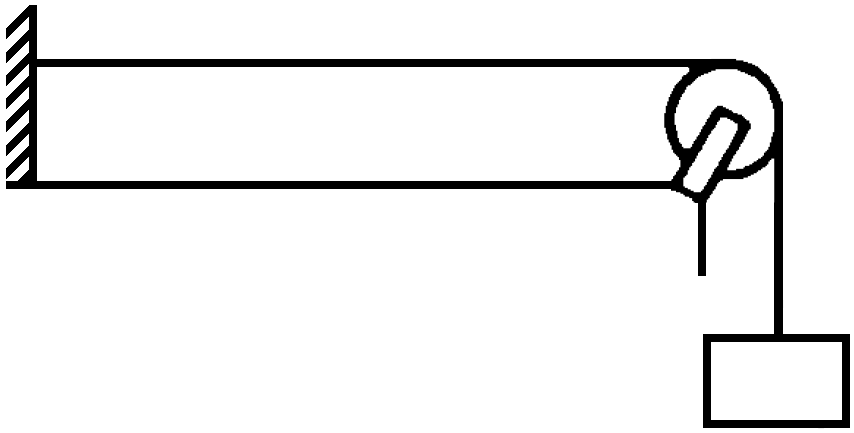
Figure, shows a string stretched by a block going over a pulley. The string vibrates in its tenth harmonic in unison with a particular tuning fork. When a beaker containing water is brought under the block so that the block is completely dipped into the beaker, the string vibrates in its eleventh harmonic. Find the density of the material of the block.
How many time constants will elapse before the charge on a capacitors falls to 0.1% of its maximum value in a discharging RC circuit?
A thin prism is made of a material having refractive indices 1.61 and 1.65 for red and violet light. The dispersive power of the material is 0.07. It is found that a beam of yellow light passing through the prism suffers a minimum deviation of 4.0° in favourable conditions. Calculate the angle of the prism.
Hydrogen atom in its ground state is excited by means of monochromatic radiation of wavelength $975 \stackrel{\circ}{A}$.
$i.$ How many different lines are possible in the resulting spectrum?
$ii.$ Calculate the longest wavelength amongst them. You may assume the ionization energy for hydrogen atom as $13.6 eV .$
A resistor of $200 \Omega$ and a capacitor of $15.0 \mu F$ are connected in series to a $220 V , 50 Hz \ ac$ source. $(a)$ Calculate the current in the circuit; $(b)$ Calculate the voltage $\text{(rms)}$ across the resistor and the capacitor. Is the algebraic sum of these voltages more than the source voltage? If yes, resolve the paradox.
Which is easier to remove: orbital electron from an atom or a nucleon from a nucleus?
Find the binding energy per nucleon of $\text{ }^{197}_{79}\text{Au}$ if its atomic mass is 196.96u.