MCQ
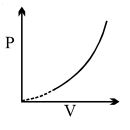
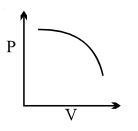
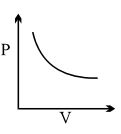
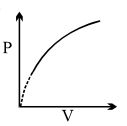
An ideal gas follows a process $PT =$ constant. The correct graph between pressure $\&$ volume is
  • A

  • B


  • D

Answer

Correct option: C.

c
$P T=$ constant

From ideal gas equation

$P V=n R T$

$T=\frac{P V}{n R}$

Put value of temperature in above equation. $P T=$ constant $P \frac{P V}{n R}=$ constant

$P^{2}=\frac{\text { constant }}{V}$

$P \propto \frac{1}{\sqrt{V}}$

Hence, the graph will be rectangular hyperbola.

Thus option $\mathrm{C}$ is correct.

Need a full question paper?

Generate a complete, print-ready paper with questions like this in minutes — across 16+ boards, with answer keys.

Start Generating Free

Similar questions

A person with his hands in his pockets is skating on ice at the velocity of $10 \,m/s$ and describes a circle of radius $50\, m$. What is his inclination with vertical
The coefficient of performance of a Carnot refrigerator working between ${30^o}C$ and ${0^o}C$ is
Two particles of masses $1\ kg$  and $3\ kg$ move towards each other under their mutual force of attraction. No other force acts on them. When the relative velocity of approach of the two particles is $2\ m/s,$ their centre of mass has a velocity of $0.5 \ m/s$. When the relative velocity of approach becomes $3\ m/s,$ the velocity of the centre of mass is ........ $m/s$.
A frame of reference that is accelerated with respect to an inertial frame of reference is called a non-inertial frame of reference. A coordinate system fixed on a circular disc rotating about a fixed axis with a constant angular velocity $\omega$ is an example of a non-intertial fiame of reference. The relationship between the force $\vec{F}_{\text {rot }}$ experienced by a particle of nass in moving on the rotating disc and the force $\vec{F}_{\text {in }}$ experienced by the particle in an inertial frame of reference is

$\vec{F}_{\text {rot }}=\vec{F}_{\text {in }}+2 m\left(\vec{v}_{\text {rot }} \times \vec{\omega}\right)+m(\vec{\omega} \times \vec{r}) \times \vec{\omega},$

where $\vec{v}_{\text {rot }}$ is the velocity of the particle in the rotating frame of reference and $\bar{r}$ is the position vector of the particle with respect to the centre of the disc.

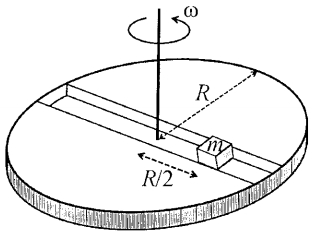
Now consider a smooth slot along a diameter of a disc of radius $R$ rotating counter-clockwise with a constant angular speed $\omega$ about its vertical axis through its center. We assign a coordinate system with the origin at the center of the disc, the $x$-axis along the slot, the $y$-axis perpendicular to the slot and the $z$-axis along the rotation axis $(\vec{\omega}=\omega \hat{k})$. A sm a $1$ block of mass $m$ is gently placed in the slot at $\vec{r}=(R / 2) \hat{i}$ at $t=0$ and is constrained to move only along the slot.

(Image)

($1$) The distance $r$ of the block at time $t$ is

($A$) $\frac{R}{4}\left(e^{\omega t}+e^{-\omega t}\right)$   ($B$) $\frac{R}{2} \cos \omega t$   ($C$) $\frac{R}{4}\left(e^{2 \omega t}+e^{-2 \omega t}\right)$

($D$) $\frac{F}{2} \cos 2 \omega t$

($2$) The net reaction of the disc on the block is

($A$) $\frac{1}{2} m \omega^2 R\left(e^{2 \omega t}-e^{-2 \omega t}\right) \hat{j}+m g \hat{k}$

($B$) $\frac{1}{2} m \omega^2 R\left(e^{\omega t}-e^{-a t t}\right) j+m g k$

($C$) $-m \omega^2 R \cos \omega t \hat{j}-m g \hat{k}$

($D$) $m \omega^2 R \sin \omega t \hat{j}-m g \hat{k}$

Give the answer quetioin ($1$) ($2$)
$Assertion$ : On a rainy day it is difficult to drive a car or bus at high speed.
$Reason$ : The value of coefficient of friction is lowered due to wetting of the surface
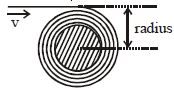
The given diagram shows a straight length of tape being wound on to a reel. The reel is rotating about a fixed axis with constant angular velocity and its radius is increasing at a steady rate. Which graph correctly shows the variation with time of the speed $v$ at which the tape moves towards the roll ?
A bomb is projected with $200\,m/s$ at an angle $60^o$ with horizontal. At the highest  point, it explodes into three particles of equal masses. One goes vertically upward with  velocity $100\,m/sec$, second particle goes vertically downward with the same velocity as  the first. Then what is the velocity of the third one-
A planet moves around the sun. At a given point $P$, it is closest from the sun at a distance ${d_1}$ and has a speed ${v_1}$. At another point $ Q$, when it is farthest from the sun at a distance ${d_2}$, its speed will be
A wire of length $L$ is hanging from a fixed support. The length changes to $L _{1}$ and $L _{2}$ when masses $1 \,kg$ and $2 \,kg$ are suspended respectively from its free end. Then the value of $L$ is equal to ..................
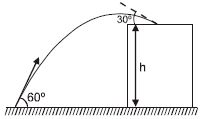
A stone projected at an angle of $60^o$ from the ground level strikes at an angle of $30^o$ on the roof of a building of height $‘h= 30\,m ’$ . Find the speed of projection(in $m/s$ ) of the stone