MCQ
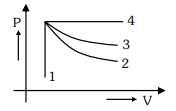
An ideal gas undergoes four different processes from the same initial state as shown in the figure below. Those processes are adiabatic, isothermal, isobaric and isochoric. The curve which represents the adiabatic process among $1,2,3$ and $4$ is
  • $2$
  • B
    $3$
  • C
    $4$
  • D
    $1$

Answer

Correct option: A.
$2$
a
$1$ : Isochoric

$2$: Adiabatic

$3$ : Isothermal

$4$: Isobaric

Need a full question paper?

Generate a complete, print-ready paper with questions like this in minutes — across 16+ boards, with answer keys.

Start Generating Free

Similar questions

The graph between terminal velocity (along $y-axis$ ) and square of radius (along $x-axis$ ) of spherical body of density $\rho $ allowed to fall through a fluid of density $\rho $  is $a$
A body travels uniformly a distance of $ (13.8 \pm 0.2) m$ in a time $(4.0 \pm 0.3)\, s$. The velocity of the body within error limits is
Weight of a body is maximum at
A pulse is generated at lower end of a hanging rope of uniform density and length $L$. The speed of the pulse when it reaches the mid point of rope is ......
A particle moves in a circular path of radius $R$ with an angular velocity $\omega = a -bt$ where $a$ and $b$ are positive constants and $t$ is time. The magnitude of the acceleration of the particle after time $\frac {2a}{b}$ is
Four particle of masses $m, 2m, 3m$ and $4m$ are arranged at the corners of a parallelogram with each side equal to $a$ and one of the angle between two adjacent sides is $60^o$. The parallelogram lies in the $x-y$ plane with mass m at the origin and $4m$ on the  $x-$ axis. The centre of mass of the arrangement will be located at 
Different minerals are being mined from within the earth and multi-storeyed complexes are being constructed. Due to this activity theoretically
The eccentricity of earth's orbit is $0.0167$. The ratio of its maximum speed in its orbit to its minimum speed is
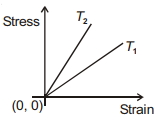
Figure shows graph between stress and strain for a uniform wire at two different femperatures. Then
A simple pendulum has time period $T_1$. The point of suspension is now moved upward according to equation $y = k{t^2}$ where $k = 1\,m/se{c^2}$. If new time period is $T_2$ then ratio $\frac{{T_1^2}}{{T_2^2}}$ will be