MCQ
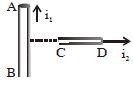
An infinitely long straight conductor $AB$ is fixed and a current is passed through it. Another movable straight wire $CD$ of finite length and carrying current is held perpendicular to it and released. Neglect weight of the wire
  • A
    The rod $CD$ will move upwards parallel to itself
  • B
    The rod $CD$ will move downwards parallel to itself
  • The rod $CD$ will move upward and turn clockwise at the same time
  • D
    The rod $CD$ will move upward and turn anti-clockwise at the same time
Answer

Correct option: C.
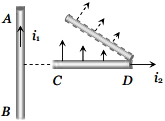
The rod $CD$ will move upward and turn clockwise at the same time
c
since the force on the rod $\mathrm{CD}$ is non-uniform it will experience force and torque. From the left hand side it can be seen that the force will be upward and torque is clockwise.

Need a full question paper?

Generate a complete, print-ready paper with questions like this in minutes — across 16+ boards, with answer keys.

Start Generating Free

Similar questions

A rod of length $l$ rotates with a uniform angular velocity $\omega $ about an axis passing through its middle point but normal to its length in a uniform magnetic field of induction $B$ with its direction parallel to the axis of rotation. The induced $emf$ between the two ends of the rod is
In compound microscope, the focal length of the objective and eye lens are $2.5\, cm$ and $5\,cm$ respectively. An object is at $3.75\, cm$ before the objective and image is formed at the least distance of distinct vision, then the distance between two lenses will be.......$cm$ (i.e. length of the microscope tube)
If a convex lens of focal length $80 \;cm$ and a concave lens of focal length $50 \;cm$ are combined together, what will be their resulting power
A small magnet is placed perpendicular to a uniform magnet field. The forces acting on the magnet will result in:
In a Wheatstone’s bridge all the four arms have equal resistance $R$. If the resistance of the galvanometer arm is also $R$, the equivalent resistance of the combination as seen by the battery is
The plates of a capacitor are charged to a potential difference of $320 \, volts$ and are then connected across a resistor. The potential difference across the capacitor decays exponentially with time. After $1 $ second the potential difference between the plates of the capacitor is $240 \, volts$, then after $2$ and $3$ seconds the potential difference between the plates will be
In a compound microscope cross-wires are fixed at the point
A ring of radius $R$ is charged uniformly with a charge $+\,Q$ . The electric field at a point on its axis at a distance $r$ from any point on the ring will be
The minimum distance between an object and its real image formed by a convex lens is
In the circuit, shown the galvanometer $G$ of resistance $60\, \Omega$ is shunted by a resistance $r=0.02\, \Omega$. The current through $R$ (in $ohm$) is nearly $1\, A$. The value of resistance $R$ (in $ohm$) is nearly (in $\Omega$)