MCQ
In a compound microscope cross-wires are fixed at the point
  • Where the image is formed by the objective
  • B
    Where the image is formed by the eye-piece
  • C
    Where the focal point of the objective lies
  • D
    Where the focal point of the eye-piece lies

Answer

Correct option: A.
Where the image is formed by the objective
a
( a)Cross wire arrangement is used to make measurements.

Need a full question paper?

Generate a complete, print-ready paper with questions like this in minutes — across 16+ boards, with answer keys.
Start Generating Free

Similar questions

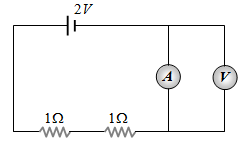
In the circuit shown, A and V are ideal ammeter and voltmeter respectively. Reading of the voltmeter will be

A particle with ${10^{ - 11}}\,coulomb$ of charge and ${10^{ - 7}}\,kg$ mass is moving with a velocity of ${10^8}\,m/s$ along the $y$-axis. A uniform static magnetic field $B = 0.5\,Tesla$ is acting along the $x$-direction. The force on the particle is
When a metallic surface is illuminated with monochromatic light of wavelength $l$, the stopping potential is $5$ $V_0$. When the same surface is illuminated with light of wavelength $3 \lambda $, the stopping potential is $V_0$. Then the work function of the metallic surface is :
If ${E_0}$ represents the peak value of the voltage in an ac circuit, the r.m.s. value of the voltage will be
Magnetic dipole moment is a vector quantity directed from:
A beam of electrons and protons move parallel to each other in the same direction, then they
What is the coefficient of mutual inductance when the magnetic flux changes by $2 \times 10^{-2} \mathrm{~Wb}$ and change in current is 0.01A
A lens which has focal length of 4 cm and refractive index of 1.4 is immersed in a liquid of refractive index 1.6, then the focal length will be
The radioactive sources $A$ and $B$ of half lives of $2\, hr$ and $4\, hr$ respectively, initially contain the same number of radioactive atoms. At the end of $2\, hours,$ their rates of disintegration are in the ratio :
When an electron does transition from $n=4$ to $n=2$, then emitted line spectrum will be