MCQ
An iso-profit line represents:
  • A
    An infinite number of solutions all of which yield the same profit.
  • B
    An infinite number of solution all of which yield the same cost.
  • C
    An infinite number of optimal solutions.
  • D
    A boundary of the feasible region.

Answer

  1. An infinite number of solutions all of which yield the same profit.

Solution:

The graph of the profit function is called an iso profit line. It is called this because iso means same or equal and the profit anywhere on the line is the same.

So, an iso-profit lines represents an infinite number of solutions all of which yield the same profit.

Need a full question paper?

Generate a complete, print-ready paper with questions like this in minutes — across 16+ boards, with answer keys.

Start Generating Free

Similar questions

Find the identity element in the set I+ of all positive integers defined by a × b = a + b for all a, b ∈ I+.
  1. 1
  2. 2
  3. 3
  4. 0
The derivative of $\cos^{-1}(2\text{x}^2-1)$ with respect to $\cos^{-1}\text{x}$ is:
  1. $2$
  2. $\frac{1}{2\sqrt{1+\text{x}^2}}$
  3. $\frac{2}{\text{x}}$
  4. $1-\text{x}^2$
Choose the correct answer from the given four options.

If $\text{P}(\text{A}\cap\text{B})=\frac{7}{10},$ and $\text{P}(\text{B})=\frac{17}{20},$ then $\text{P}\Big(\frac{\text{A}}{\text{B}}\Big)$ equas:

  1. $\frac{14}{17}$

  2. $\frac{17}{20}$

  3. $\frac{7}{8}$

  4. $\frac{1}{8}$

The matrix $A=\left[\begin{array}{ll}0 & 1 \\ 1 & 0\end{array}\right]$ is a
A stone throw upward having speed equation $S =9.8 t-4.9 t^2$ where S in $m / s$. What will be the time to achieve maximum height ?
Let $A=\{1,2,3\}, B=\{4,5,6,7\}$ and let $f=\{(1,4),(2,5)$, $(3,6)\}$ be a function from $A$ to $B$. Based on the given information, $f$ is best defined as
Let $f ( x )=\min \{1,1+ x \sin x \}, 0 \leq x \leq 2 \pi$. If $m$ is the number of points, where $f$ is not differentiable and $n$ is the number of points, where $f$ is not continuous, then the ordered pair $( m , n )$ is equal to
If a $3-$digit number is randomly chosen. What is the probability that either the number itself or some permutation of the number (which is a $3-$digit number) is divisible by $4$ and $5$ ?
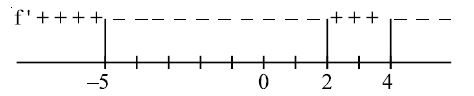
 $(i)$  $f (x)$ is continuous and defined for all real numbers

$(ii)$ $f '(-5) = 0 \,; \,f '(2)$ is not defined and $f '(4)  = 0$

$(iii)$ $(-5, 12)$ is a point which lies on the graph of $f (x)$

$(iv)$ $f ''(2)$ is undefined, but $f ''(x)$ is negative everywhere else.

$(v)$ the signs of  $f '(x)$ is given below

On the possible graph of $y = f (x)$ we have  

The derivative of $\tan ^{-1}\left(\frac{\sqrt{1+x^{2}}-1}{x}\right)$ with respect to $\tan ^{-1}\left(\frac{2 x \sqrt{1-x^{2}}}{1-2 x^{2}}\right)$ at $x=\frac{1}{2}$ is