MCQ
An isolated solid metallic sphere is given $ + Q$ charge. The charge will be distributed on the sphere
  • Uniformly but only on surface
  • B
    Only on surface but non-uniformly
  • C
    Uniformly inside the volume
  • D
    Non-uniformly inside the volume

Answer

Correct option: A.
Uniformly but only on surface
a
(a) The charge given to a sphere will be distributed uniformly over the surface.

Need a full question paper?

Generate a complete, print-ready paper with questions like this in minutes — across 16+ boards, with answer keys.

Start Generating Free

Similar questions

Two identical charged spheres are suspended by string of equal lengths. The string make an angle of $37^{\circ}$ with each other. When suspended in a liquid of density $0.7 \mathrm{~g} / \mathrm{cm}^3$, the angle remains same. If density of material of the sphere is $1.4 \mathrm{~g} / \mathrm{cm}^3$, the dielectric constant of the liquid is_____$\left(\tan 37^{\circ}=\frac{3}{4}\right)$.
A small square loop of side $'a'$ and one turn is placed inside a larger square loop of side ${b}$ and one turn $(b \gg a)$. The two loops are coplanar with thei centres coinciding. If a current $I$ is passed in the square loop of side $'b',$ then the coefficient of mutual inductance between the two loops is
A rod of length $20$ cm is rotating with angular speed of $100$ rps in a magnetic field of strength $0.5$ T about it’s one end. What is the potential difference between two ends of the rod.......$V$
Consider $3^{rd}$ orbit of $He^{+}$ (Helium) using non-relativistic approach , the speed of electron in this orbit will be

[ given $K=9 \times 10^9$ constant ,$Z=2$ and $h$ (Planck 's constant) $=6.6\times10^{-34}\,\,Js$  ]
The plates of a capacitor are charged to potential difference of $V\, volts$ and then  connected across a resistor. The potential difference across the capacitor decreases  exponentially with respect to time. After one second, the potential difference between the  plates is $V/3$; then after two seconds from the start, the potential difference between the  plates is
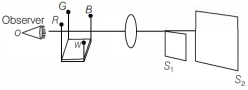
Four bulbs, red, green, white and blue (denoted by $R$ $G, W$ and $B$ respectively) are kept in front of a converging lens (as shown in the figure below). The observer sees that the green and blue bulbs are kept to the left of the principal axis, while the red and white bulbs are kept to the right of the principal axis. He also sees that the red and green bulbs are above principal axis, while the white and blue bulbs are below the principal axis. The screens $S_1$ and $S_2$ are set appropriate positions for the focusing to view the images. Choose the figure that correctly represents the images as seen by the observer.
Let the refractive index of a denser medium with respect to a rarer medium be $n_{12}$ and its critical angle be $\theta_C$.  At an angle of incidence $A$ when light is travelling from denser medium to rarer medium, a part of the light is reflected and the rest is refracted and the angle between reflected and refracted rays is $90^o$.  Angle $A$ is given by
When an unpolarized light of intensity $I _0$ is incident on a polarizing sheet, the intensity of the light which does not get transmitted is
Range of frequencies allotted for commercial FM radio broadcast is
A thin disc of radius $R$ and mass $M$ has charge $q$ uniformly distributed on it. It rotates with angular velocity $\omega$. The ratio of magnetic moment and angular momentum for the disc is