Question
An N-type semiconductor is:

Answer

(c) - insulator

Need a full question paper?

Generate a complete, print-ready paper with questions like this in minutes — across 16+ boards, with answer keys.
Start Generating Free

Similar questions

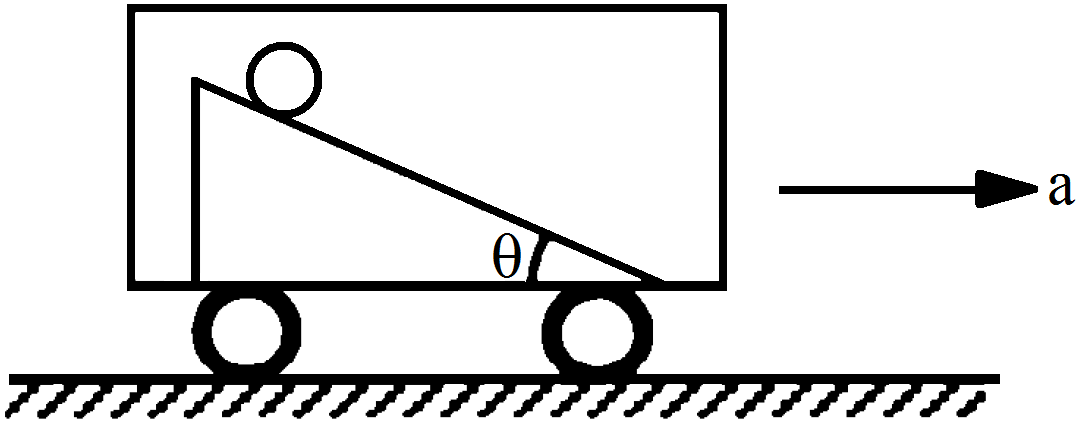
Figure shows a smooth inclined plane fixed in a car accelerating on a horizontal road. The angle of incline 0 is related to the acceleration a of the car as a = g tan°. If the sphere is set in pure rolling on the incline:
  1. It will continue pure rolling.
  2. It will slip down the plane.
  3. Its linear velocity will increase.
  4. Its linear velocity will slowly decrease.
A group of bright and faint stars is called(a) Galaxy(b) Comet(c) Black hole(d) Constellation
       
A car is moving with at a constant speed of $60\ kmh^{-1}$ on a straight road. Looking at the rear view mirror, the driver finds that the car following him is at a distance of $100m$ and is approaching with a speed of $5\ kmh^{-1}.$ In order to keep track of the car in the rear, the driver begins to glance alternatively at the rear and side mirror of his car after every $2s$ till the other car overtakes. If the two cars were maintaining their speeds, which of the following statement $(s)$ is/are correct?
A bi-convex lens made of glass (refractive index 1.5) is put in a liquid of refractive index 1.7. Its focal length will(a) Decrease and change sign(b) Increase and change sign(c) Decrease and remain of the same sign(d) Increase and remain of the same sign


The speed of sound in a medium depends on:
  1. The elastic property but not on the inertia property.
  2. The inertia property but not on the elastic property.
  3. The elastic property as well as the inertia property.
  4. Neither the elastic property nor the inertia property.
If a comb is rubbed on dry hairs, and then brought near paper pieces, it:
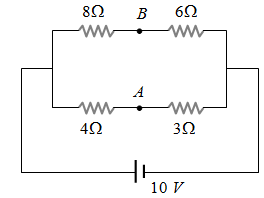
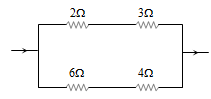
In the circuit as shown in the figure, the heat produced by $6$ ohm resistance due to current flowing in it is $60$ calorie per second. The heat generated across $3$ ohm resistance per second will be
The potential difference between point $A\ \& \ B$ is
$10$ wires $($same length, same area, same material$)$ are connected in parallel and each has $1\Omega$ resistance, then the equivalent resistance will be
Which of the following quantities is zero on an average for the molecules of an ideal gas in equilibrium?
  1. Kinetic energy.
  2. Momentum.
  3. Density.
  4. Speed.