MCQ
The potential difference between point $A\ \& \ B$ is
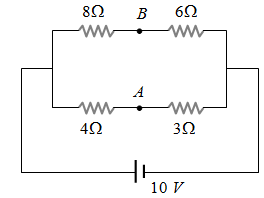
  • A
    $\frac{20}{7} \mathrm{V}$
  • B
    $\frac{40}{7} \mathrm{V}$
  • C
    $\frac{10}{7} \mathrm{V}$
  • $0$

Answer

Correct option: D.
$0$
$0$

Need a full question paper?

Generate a complete, print-ready paper with questions like this in minutes — across 16+ boards, with answer keys.

Start Generating Free

Similar questions

Kirchoff’s first law, i.e., S i = 0 at a junction, deals with the conservation of:
Magnetic moment of a thin bar magnet is M. If it is cut first perpendicular to length and then perpendicular to breadth, then magnetic moment of obtained piece is:
Nuclear force is :
Image formed by a convex mirror is(a) Virtual(b) Real(c) Enlarged(d) Inverted
       
In Bohr’s model of hydrogen atom, which of the following pairs of quantities are quantized(a) Energy and linear momentum(b) Linear and angular momentum(c) Energy and angular momentum(d) None of the above
   
   
A cork floating in a calm pond executes simple harmonic motion of frequency v when a wave generated by a boat passes by it. The frequency of the wave is:
  1. $\text{v}$
  2. $\frac{\text{v}}{2}$
  3. $2\text{v}$
  4. $\sqrt{2}\text{v}.$
Binding energy of a nucleus is of the order of.
What will be the colour of sky as seen from the earth, if there were no atmosphere(a) Black  (b) Blue(c) Orange(d) Red
       
A piece of semiconductor is connected in series in an electric circuit. On increasing the temperature, the current in the circuit will(a) Decrease(b) Remain unchanged(c) Increase(d) Stop flowing
       
A charge $(-q)$ and another charge $(+Q)$ are kept at two points $A$ and $B$ respectively. Keeping the charge $(+Q)$ fixed at $B,$ the charge $(-q)$ at $A$ is moved to another point $C$ such that $\text{ABC}$ forms an equilateral triangle of side $l.$ The net work done in moving the charge $(-q)$ is