Question
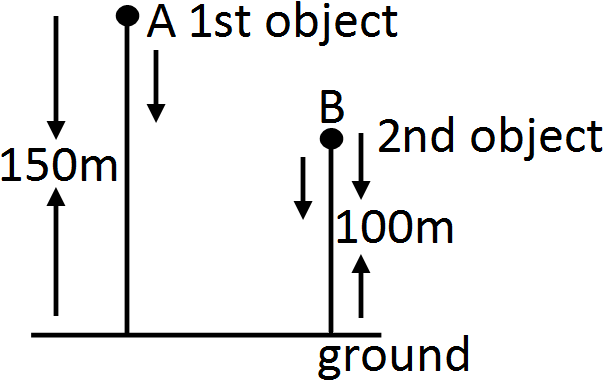
An object is dropped from rest at a height of $150m$ and simultaneously another object is dropped from rest at a height $100m.$ What is the difference in their heights after $2s$ if both the objects drop with same accelerations? How does the difference in heights vary with time?
Answer

For first object given, $u = 0 ($because object dropped from rest$)$ and time$ (t) = 2s$ from second equation of motion, the distance covered by first object in $2s$ is$\text{h}=\text{ut}+\frac{1}{2}\text{gt}^2$
$\text{h}=0\times2+\frac{1}{2}\times10\times(2)^2\ [\because\text{g}=10\text{m/ s}^{2}]$
$\text{h}=0+\frac{1}{2}\times10\times4=20\text{m}$

Height of first object from the ground after $2s (h_1) = 150m - 20m = 130m$ for second object guven, $u = 0$ and time $(t) = 2s$ From second equation of motion, the distance covered by second object in $2s$ is $\text{h}=\text{ut}+\frac{1}{2}\text{gt}^2=0\times2+\frac{1}{2}\times10\times(2)^2\ [\because\text{g}=10\text{m/ s}^2]$
$=0+\frac{1}{2}\times1=\times4=20\text{m}$
Height of second object from the ground after $2s$ then $h_2 = 100m – 20m = 80m$
Now, difference in the height after $2s = h_1 – h_2 = 130 – 80 = 50 m$
The difference in hights of the objects will remain same with time as both the objects have been dropped from rest and are falling with same acceleration i.e $($acceleration due to gravity$).$

Need a full question paper?

Generate a complete, print-ready paper with questions like this in minutes — across 16+ boards, with answer keys.

Start Generating Free

Similar questions

State and explain Newton’s second law of motion.
If a planet existed whose mass was twice that of the earth and whose radius is $3$ times greater. How much will a $1\ kg$ mass weigh in the planet?
  1. How does a boat float in water?
  2. A piece of steel has a volume of $12\ cm^3,$ and a mass of $96g$. What is its density: $(i)$ in $g/cm^{3 }\ (ii)$ in $kg/m^3$?
Differentiate between a saturated and an unsaturated solution. How will you test whether a given solution is saturated or not?
With the help of a labelled diagram, describe the method of separating ammonium chloride from a mixture of ammonium chloride and common salt. Mention the difference in the properties of ammonium chloride and sodium chloride which has made this separations possible.
Write down symptoms of sick animals. Discuss any two diseases of cattle.
Write a note on cattle feed.
Give an account of structure and function of xylem.
Iron powder and sulphur powder were mixed together and divided into two parts A and B. When part A was heated strongly over a burner, then a substance C was formed. The part B was, however, not heated at all. When dilute hydrochloric acid was added to substance C, then gas D was evolved and when dilute hydrochloric acid was added to part B then gas E was evolved.
  1. What type of substance is B?
  2. What type of substance is C?
  3. Name the gas (i) D, and (ii) E?
  4. Write one characteristic property of gas D.
How can you obtain pure water from a salt-water mixture (or salt-solution)? Draw a meat and labelled diagram of the apparatus you would use to obtain pure water from a salt-water mixture (or salt-solution).