MCQ
An object is located in a fixed position in front of a screen. Sharp image is obtained on the screen for two positions of a thin lens separated by $10\, cm$. The size of the images in two situations are in the ratio $3 : 2$. What is the distance between the screen and the object?......$cm$
  • A
    $124.5$
  • B
    $144.5$
  • C
    $65$
  • $99$

Answer

Correct option: D.
$99$
d
Given: Separation of lens for two of its position, $d=10 \mathrm{cm}$

Ratio of size of the images in two positions

$\frac{I_{1}}{I_{2}}=\frac{3}{2}$

Distance of object from the screen, $D=?$

Applying formula,

${\frac{{{I_1}}}{{{I_2}}} = \frac{{{{(D + d)}^2}}}{{{{(D - d)}^2}}}}$

${ \Rightarrow \,\,\frac{3}{2} = \frac{{{{(D + 10)}^2}}}{{{{(D - 10)}^2}}}}$

${ \Rightarrow \quad \frac{3}{2} = \frac{{{D^2} + 100 + 20D}}{{{D^2} + 100 - 20D}}}$

$\Rightarrow 3 D^{2}+300-60 D=2 D^{2}+200+40 D$

$\Rightarrow \quad D^{2}-100 D+100=0$

On solving, we get $D=99\, \mathrm{cm}$

Hence the distance between the screen and the object is $99\, \mathrm{cm} .$

Need a full question paper?

Generate a complete, print-ready paper with questions like this in minutes — across 16+ boards, with answer keys.

Start Generating Free

Similar questions

Energy of $H-$ atom in the ground state is $-13.6\;eV$, The energy needed to ionise a hydrogen atom which is in its second excited state is .......$eV$
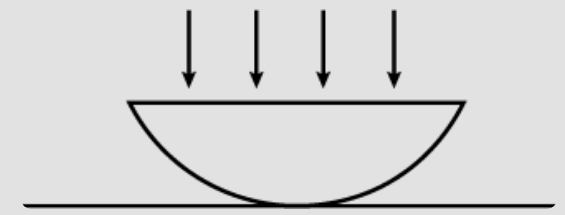
A thin slice is cut out of a glass cylinder along a plane parallel to its axis. The slice is placed on a flat glass plae as shown in figure. The observed interference fringes from this combination shall be:
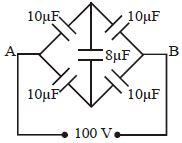
Five capacitors are connected to a $DC$ potential of $100\,V$ as shown in the adjoining figure. Find charge in $10\,μF$ capacitor.......$\mu C$
What is the net electric field in the outer regions above the upper plate and below the lower plate in a parallel plate capacitor?
n equal resistors are first connected in series and then connected in parallel. What is the ratio of the maximum to the minimum resistance
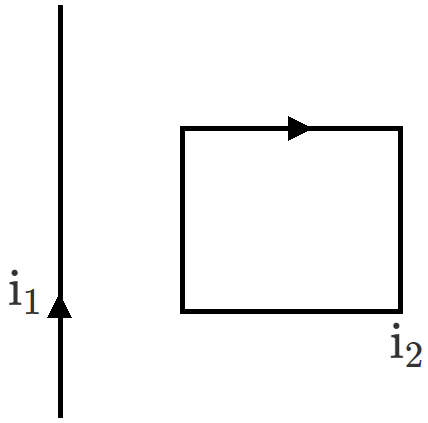
Consider the situation shown in figure. The straight wire is fixed but the loop can move under magnetic force. The loop will:
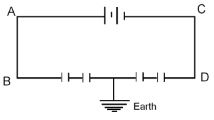
Four equal capacitors are connected to a battery as shown in the adjoining figure. The potential of $A$ and $B$ are
Consider the following statements in case of Young's double slit experiment 
$(1)$ A slit is necessary if we use an ordinary extended source of light
$(2)$ A slit is not necessary if we use an ordinary but well collimated beam of light
$(3)$ A slit is not needed if we use a spatially coherent point source of light
Which of the above statements is true ?
In a $PN-$ junction diode not connected to any circuit
If luminous efficiency of a lamp is 2 lumen/watt and its luminous intensity is 42 candela, then power of the lamp is