MCQ
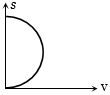
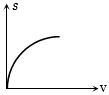
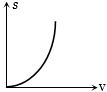
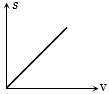
An object is moving with a uniform acceleration which is parallel to its instantaneous direction of motion. The displacement $(s) - $ velocity $(v)$ graph of this object is
  • A

  • B


  • D

Answer

Correct option: C.

c
(c) ${v^2} = {u^2} + 2aS$, If $u = 0$ then ${v^2} \propto S$

i.e. graph should be parabola symmetric to displacement axis.

Need a full question paper?

Generate a complete, print-ready paper with questions like this in minutes — across 16+ boards, with answer keys.

Start Generating Free

Similar questions

Match List $I$ with List $II$

LIST$-I$ LIST$-II$
$(A)$ Surface tension $(I)$ $Kg m ^{-1} s ^{-1}$
$(B)$ Pressure $(II)$ $Kg ms^{-1 }$
$(C)$ Viscosity $(III)$ $Kg m ^{-1} s ^{-2}$
$(D)$ Impulse $(IV)$ $Kg s ^{-2}$

Choose the correct answer from the options given below :

The position of a body moving along $x$-axis at time $t$ is given by $x=\left(t^2-4 t+6\right) m$. The distance travelled by body in time interval $t=0$ to $t=3 \,s$ is ...... $m$
Which physical quantities have the same dimension
The value of coefficient of volume expansion of glycerin is $5 \times 10^{-4} K^{-1}$. The fractional change in the density of glycerin for a rise of $40^{\circ} C$ in its temperature, is
Two identical solid spheres each of mass $2\,kg$ and radii $10\,cm$ are fixed at the ends of a light rod. The separation between the centres of the spheres is $40\,cm$. The moment of inertia of the system about an axis perpendicular to the rod passing through its middle point is $........... \times 10^{-3}\,kg - m ^2$
If fundamental frequency of closed pipe is $50\,Hz$ then frequency of $2^{nd}$ overtone is .... $Hz$
The equation of a progressive wave can be given by $\text{y}=15\sin(600\pi\text{t}-0.02\pi\text{x})\text{cm}.$ The frequency of the wave is:
A solid cylinder of mass $M$ and radius $R$ rolls without slipping down an inclined plane of length $L$ and height $h$.  What is the speed of its centre of mass when the cylinder reaches its bottom 
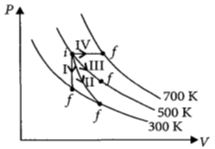
Thermodynamic processes are indicated in the following diagram. 

Match the following

 $\begin{array}{|l|l|} \hline Column\,\,-\,\,1 & Column\,\,-\,\,2 \\ \hline P\,:\,Process\,\,-\,\,I & \,\,A\,\,:\,\,Adiabatic \\ \hline Q\,:\,Process\,\,-\,\,II & \,\,B\,\,:\,\,Isobaric \\ \hline R\,:\,Process\,\,-\,\,III & \,\,C\,\,:\,\,Isochoric \\ \hline S\,:\,Process\,\,-\,\,IV & \,\,D\,\,:\,\,Isothermal \\ \hline \end{array}$
 

A particle is pushed by forces $2\hat{\text{i}}+3\hat{\text{j}}-2\hat{\text{k}}$ and $5\hat{\text{i}}+\hat{\text{j}}-2\hat{\text{k}}$ simultaneously and it is displaced from point $\hat{\text{i}}+\hat{\text{j}}+\hat{\text{k}}$ to point $2\hat{\text{i}}-\hat{\text{j}}-2\hat{\text{k}}$. The work done is: