MCQ
An object is placed at a distance u from a simple microscope of focal length f. The angular magnification obtained depends:
  • A
    On f but not on u.
  • B
    On u but not on f.
  • On f as well as u.
  • D
    Neither on f nor on u.

Answer

Correct option: C.
On f as well as u.
​The angular magnification is the ratio of the angle subtended by the image to the angle subtended by the object on an unaided eye.
In a simple microscope,
$\text{m}=\frac{\frac{\text{h}}{\text{x}}}{\frac{\text{h}}{\text{D}}}$
Here,
u = Object distance from the lems
D = Image distance form the lens
h = Height of the object
In normal adjustment, the object is placed at a distance equal to focal length (f) from the lens and then magnification is given by m
$=\frac{\text{D}}{\text{f}}$
for $\text{u}<\text{f},\text{ m}=\frac{\text{D}}{\text{f}}+1$

Need a full question paper?

Generate a complete, print-ready paper with questions like this in minutes — across 16+ boards, with answer keys.
Start Generating Free

Similar questions

Two bodies of mass $3\, kg$ and $4\, kg$ are suspended at the ends of massless string passing over a frictionless pulley. The acceleration of the system is ........ $m/{s^2}$  $(g = 9.8\,m/{s^2})$ 
In a stationary wave,
  1. All the particles of the medium vibrate in phase.
  2. All the antinodes vibrate in phase.
  3. The alternate antinodes vibrate in phase.
  4. All the particles between consecutive nodes vibrate in phase.
The workdone by a gas molecule in an isolated system is given by, $W =\alpha \beta^{2} e ^{-\frac{ x ^{2}}{\alpha kT }},$ where $x$ is the displacement, $k$ is the Boltzmann constant and $T$ is the temperature, $\alpha$ and $\beta$ are constants. Then the dimension of $\beta$ will be
The number of possible natural oscillations of air column in a pipe closed at one end of length 85 cm whose frequencies lie below 1250 Hz are (velocity of sound $=340 ms^{-1}$ )
When heat in given to a gas in an isobaric process, then
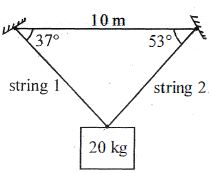
A mass of $20\  kg$ is hanging with support of two strings of same linear mass density. Now pulses are generated in both strings at same time near the joint at mass. Ratio of time, taken by a pulse travel through string $1$ to that taken by pulse on string $2$ is
A second harmonic has to be generated in a string of length $l$ stretched between two rigid supports. The point where the string has to be plucked and touched are
............  $gm$ of a liquid of specific heat $0.2$ at a temperature $40°C$ must be mixed with $100 \,gm$ of a liquid of specific heat of $0.5 $ at a temperature $20°C,$ so that the final temperature of the mixture becomes $32°C$
Three copper blocks of masses $M_1, M_2$ and $M_3\ kg$ respectively are brought into thermal contact till they reach equilibrium. Before contact, they were at $T_1, T_2, T_3 (T_1 > T_2 > T_3).$ Assuming there is no heat loss to the surroundings, the equilibrium temprature $T$ is $(s$ is specific heat of copper$)$
A body projected vertically from the earth reaches a height equal to earth's radius before returning to the earth. The power exerted by the gravitational force is greatest