MCQ
An object is placed in front of a spherical mirror whose $2\, times$ magnified image is formed on screen. Then choose $CORRECT$ option
  • A
    Mirror is concave $m = +2$
  • Mirror is concave $m = -2$
  • C
    Mirror is concavex $m = +2$
  • D
    Mirror is concavex $m = -2$

Answer

Correct option: B.
Mirror is concave $m = -2$
b
Image is formed two times then magnification $=  -2$ mirror is concave.

Need a full question paper?

Generate a complete, print-ready paper with questions like this in minutes — across 16+ boards, with answer keys.

Start Generating Free

Similar questions

A singly ionised helium atom in an excited state $(n=4)$ emits a photon of energy $2.6 \,eV$. Given that the ground state energy of hydrogen atom is $-13.6 \,eV$, the energy $E_f$ and quantum number $n$ of the resulting state are respectively,
The number of electrons to be put on a spherical conductor of radius 0.1m to produce an electric field of 0.036 N/C just above its surface is 
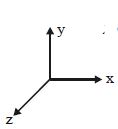
Light wave is travelling along $y-$ direction. If the corresponding $\vec E$ vector at any time is along the $x-$ axis, the direction of $\vec B$ vector at that time is along
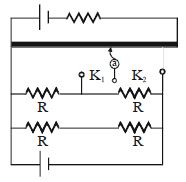
In potentiometer experiment when $K_1$ is closed balance length is $100\,cm$. Then what will be balancing length when $K_2$ is closed ................ $\mathrm{cm}$
Kirchhoff's second law is based on the law of conservation of
The magnetic moment of a circular coil carrying current is
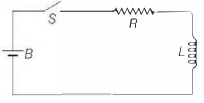
The circuit shown consists of a switch $S$, a battery $B$ of emf $E$, a resistance $R$ and an inductor $L$. The current in the circuit at the instant. The switch is closed to
$A$ copper rod $AB$ of length $L$, pivoted at one end $A$, rotates at constant angular velocity $\omega$ , at right angles to $a$ uniform magnetic field of induction $B$. The $e.m.f$ developed between the mid point $C$ of the rod and end $B$ is
Choose the correct statement
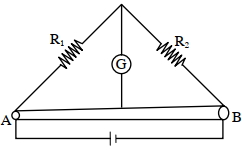
Two resistances $R_1=X \Omega$ and $R_2=1 \Omega$ are connected to a wire $A B$ of uniform resistivity, as shown in the figure. The radius of the wire varies linearly along its axis from $0.2 mm$ at $A$ to $1 mm$ at $B$. A galvanometer ($G$) connected to the center of the wire, $50 cm$ from each end along its axis, shows zero deflection when $A$ and $B$ are connected to a battery. The value of $X$ is. . . . .