MCQ
An object is projected in the air with initial velocity $u$ at an angle $\theta$. The projectile motion is such that the horizontal range $R$, is maximum. Another object is projected in the air with a horizontal range half of the range of first object. The initial velocity remains same in both the case. The value of the angle of projection, at which the second object is projected, will be $.......$ degree.
  • A
    $85$
  • B
    $80$
  • $15$ or $75$
  • D
    $70$

Answer

Correct option: C.
$15$ or $75$
c
$R _{\max }=\frac{ u ^{2} \sin 2\left(45^{\circ}\right)}{ g }=\frac{ u ^{2}}{ g }$

$\frac{ R }{2}=\frac{ u ^{2}}{2 g }=\frac{ u ^{2} \sin 2 \theta}{ g }$

$\sin 2 \theta=\frac{1}{2}$

$2 \theta=30^{\circ}, 150^{\circ}$

$\theta=15^{\circ}, 75^{\circ}$

Ans. $15, 75$

Need a full question paper?

Generate a complete, print-ready paper with questions like this in minutes — across 16+ boards, with answer keys.

Start Generating Free

Similar questions

Out of the following which one is a forward biased diode? 
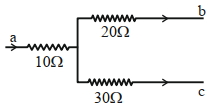
Figure shows a part of an electric circuit. The potentials at points $a , b$ and $c$ are $30\,V , 12\,V$ and $2\,V$ respectively. The current through the $20 \Omega$ resistor will be $........\,A$
$Dyne/cm^2$ is not a unit of
In the solar system, which is conserved
Assertion : The positive charge particle is placed in front of a spherical uncharged conductor. The number of lines of forces terminating on the sphere will be more than those emerging from it.

Reason : The surface charge density at a point on the sphere nearest to the point charge will be negative and maximum in magnitude compared to other points on the sphere

A truck of mass $M$ is at rest on frictionless road when a monkey of mass $m$ starts moving on the truck in forward direction.If the truck recoils with a speed $v$ backward on the road, with what velocity is the monkey moving with respect to truck ?
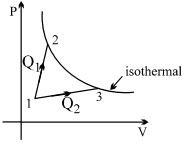
A gas takes part in two processes in which it is heated from the same initial state $1$ to the same final temperature. The processes are shown on the $P-V$ diagram by the straight line $1-2$ and $1-3$. $2$ and $3$ are the points on the same isothermal curve. $Q_1$ and $Q_2$ are the heat transfer along the two processes. Then
A satellite of $10^3 \mathrm{~kg}$ mass is revolving in circular orbit of radius $2 \mathrm{R}$. If $\frac{10^4 \mathrm{R}}{6} \mathrm{~J}$ energy is supplied to the satellite, it would revolve in a new circular orbit of radius:

(use $\mathrm{g}=10 \mathrm{~m} / \mathrm{s}^2, \mathrm{R}=$ radius of earth)

The displacement of a particle undergoing $SHM$ of time period $T$ is given by $x(t) = x_m\,cos\, (\omega t + \phi )$. The particle is at $x = -x_m$ at time $t = 0$. The particle is at $x = + x_m$ when
A jat plane is travelling towards west at a speed of $1800\, km/h$. What is the voltage difference developed between the ends of the wing having a span of $25\,m$, if the Earth's magnetic field at the location has a magnitude of $5\times10^{-4}\, T$ and the dip angle is $30^o$