An object of mass $0.2\, kg$ executes simple harmonic along $X-$ axis with frequency of $\frac{{25}}{\pi }Hz$. At the position $x = 0.04m$, the object has kinetic energy of $0.5 \,J$ and potential energy of $0.4\, J$ amplitude of oscillation in meter is equal to
Medium


Download our appand get started for free
Experience the future of education. Simply download our apps or reach out to us for more information. Let's shape the future of learning together!No signup needed.*
Similar Questions
- 1Velocity at mean position of a particle executing $S.H.M.$ is $v$, they velocity of the particle at a distance equal to half of the amplitudeView Solution
- 2View SolutionA tunnel has been dug through the centre of the earth and a ball is released in it. It will reach the other end of the tunnel after
- 3A simple pendulum with length $100\,cm$ and bob of mass $250\,g$ is executing S.H.M. of amplitude $10\,cm$. The maximum tension in the string is found to be $\frac{x}{40}\,N$. The value of $x$ is $..........$.View Solution
- 4A particle executes simple harmonic motion and is located at $x = a, b$ and $c$ at times $t_0, 2t_0$ and $3t_0$ respectively. The frequency of the oscillation isView Solution
- 5Two pendulums have time periods $T$ and $\frac{{5T}}{4}.$They start $S.H.M.$ at the same time from the mean position. What will be the phase difference between them after the bigger pendulum has complete one oscillation ..... $^o$View Solution
- 6If a spring has time period $T$, and is cut into $n$ equal parts, then the time period of each part will beView Solution
- 7View SolutionIn the situation as shown in figure time period of vertical oscillation of block for small displacements will be
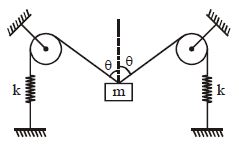
- 8Two springs of force constants $300\, N/m$ (Spring $A$) and $400\, N/m$ (Spring $B$) are joined together in series . The combination is compressed by $8.75\, cm$. The ratio of energy stored in $A$ and $B$ is $\frac{{{E_A}}}{{{E_B}}}$. Then $\frac{{{E_A}}}{{{E_B}}}$ is equal toView Solution
- 9A particle is executing simple harmonic motion with a time period $T.$ At time $t = 0$, it is at its position of equilibrium. The kinetic energy-time graph of the particle will look likeView Solution
- 10A solid cylinder of density $\rho_0$, cross-section area $A$ and length $l$ floats in a liquid of density $\rho\left( >\rho_0\right)$ with its axis vertical, as shown. If it is slightly displaced downward and released, the time period will be .......View Solution