MCQ
An object suspended by a wire stretches it by $10 \,mm$. When object is immersed in a liquid the elongation in wire reduces by $\frac{10}{3} \,mm$. The ratio of relative densities of the object and liquid is ............
  • $3: 1$
  • B
    $1: 3$
  • C
    $1: 2$
  • D
    $2: 1$

Answer

Correct option: A.
$3: 1$
a
(a)

$\Delta L=\frac{F L}{A Y}$   $\left\{\begin{array}{l}\text { Let density of liquid }=\rho \\ \text { Let density of object }=\sigma \\ \text { Mass of object }=M\end{array}\right.$

$\Rightarrow$ Elongation $\propto$ force and force is due to weight

So elongation $\propto$ weight

$\Delta L_1 \propto$ weight   $\quad \ldots (1)$  {When not submerged in liquid }

$\Delta L_2 \propto$ apparant weight $\ldots .(2)$  {When submerged in liquid }

Dividing $(1)$ by $(2)$

$\frac{10}{10-\frac{10}{3}}=\frac{M g}{M g-\frac{M g \rho}{\sigma}}$

$\Rightarrow \frac{1}{1-\frac{1}{3}}=\frac{1}{1-\frac{\rho}{\sigma}}$

Solving this we get

$\frac{\rho}{\sigma}=\frac{1}{3}$

So relative densities of object $(\sigma)$ and liquid $(\rho)$ is $3: 1$
Need a full question paper?

Generate a complete, print-ready paper with questions like this in minutes — across 16+ boards, with answer keys.

Start Generating Free

Similar questions

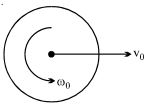
$A$ uniform sphere of radius $R$ is placed on $a$ rough horizontal surface and given a linear velocity $v_0$ angular velocity $\omega_0$ as shown. The sphere comes to rest after moving some distance to the right. It follows that:
At what height from the ground will the value of $‘g’ $ be the same as that in $10 \,km$ deep mine below the surface of earth ......... $km$
A body with mass 5kg is acted upon by a force $\text{F}=(-3\hat{\text{i}}+4\hat{\text{j}})\text{N.}$ If its initial velocity at t = 0 is $\text{v}=(6\hat{\text{i}}-12\hat{\text{j}})\text{m s}^{-1},$ the time at which it will just have a velocity along the y-axis is:
A stone of mass $20\, {g}$ is projected from a rubber catapult of length $0.1\, {m}$ and area of cross section $10^{-6} \,{m}^{2}$ stretched by an amount $0.04\, {m}$. The velocity of the projected stone is $....\,m\,/s.$ (Young's modulus of rubber $=0.5 \times 10^{9}\, {N} / {m}^{2}$ )
Two satellites of masses ${m_1}$ and ${m_2}({m_1} > {m_2})$ are revolving round the earth in circular orbits of radius ${r_1}$ and ${r_2}({r_1} > {r_2})$ respectively. Which of the following statements is true regarding their speeds ${v_1}$ and ${v_2}$ ?
A body is at rest at $x=0$. At $t=0$, it starts moving in the positive $x-$ direction with a constant acceleration. At the same instant another body passes through $x=0$ moving in the positive $x$ direction with a constant speed. The position of the first body is given by $x_{1} (t)$ after time $t$ and that of the second body by $x_{2}(t)$ after the same time interval. Which of the following graphs correctly describe $\left(x_{1}-x_{2}\right)$ as a function of time $t$?
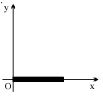
The figure shows a uniform rod lying along the $x$- axis. The locus of all the points lying on the $xy-$plane, about which the moment of inertia of the rod is same as that about $O$ is
A particle covers $50\, m$ distance when projected with an initial speed. On the same surface it will cover a distance, when projected with double the initial speed ......... $m$
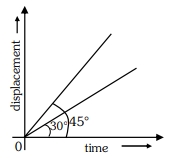
The displacement-time graphs of two moving particles make angles of $30^{\circ}$ and $45^{\circ}$ with the $x$-axis as shown in the figure. The ratio of their respective velocity is :
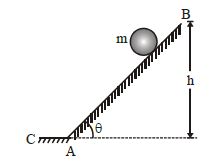
A sphere of mass $m$ comes down on a smooth inclined plane from a point $B$ at a height of $h$ from rest. The magnitude of change in momentum of the particle between the position $A$ and $C$ (assuming the angle of inclination of the plane as $\theta $ with respect to the horizontal) is