MCQ
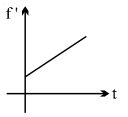
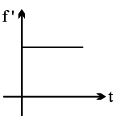
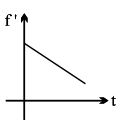
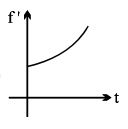
An observer starts moving with uniform acceleration $'a'$ towards a stationary sound source of frequency $f.$ As the observer approaches the source, the apparent frequency $f'$ heard by the observer varies with time $t$ as:

  • B

  • C

  • D

Answer

Correct option: A.

a
For observer approaching a stationary source

$n^{\prime}=\frac{v+v_{0}}{v} n$ and given $v_{0}=a t \Rightarrow n^{\prime}=\left(\frac{a n}{v}\right) t+n$ This is the equation

of straight line with positive intercept $n$ and positive slope $\left(\frac{n}{v}\right)$

Need a full question paper?

Generate a complete, print-ready paper with questions like this in minutes — across 16+ boards, with answer keys.
Start Generating Free

Similar questions

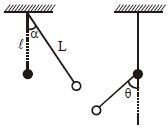
A simple pendulum consisting of a mass $M$ attached to a string of length $L$ is released from rest at an angle $\alpha$. $A$ pin is located at a distance $l$ below the pivot point. When the pendulum swings down, the string hits the pin as shown in the figure. The maximum angle $\theta$ which string makes with the vertical after hitting the pin is :-
If wavelength of a wave is $\lambda = 6000Å.$ Then wave number will be
A brass cube of side $a$ and density $\rho$ is floating in mercury of density $\sigma$. If the cube is displaced a bit vertically, it executes $S.H.M.$ Its time period will be
While measuring the thermal conductivity of a liquid, we keep the upper part hot and lower part cool, so that
In order to double the frequency of the fundamental note emitted by a stretched string, the length is reduced to $\frac{3}{4}$$^{th}$ of the original length and the tension is changed. The factor by which the tension is to be changed, is
A ball of mass $m$ is thrown vertically upwards. Another ball of mass $2m$ is thrown at an angle $\theta $ with the vertical. Both of them stay in air for same period of time. The heights attained by the two balls are in the ratio of
The only elastic modulus that applies to fluids is
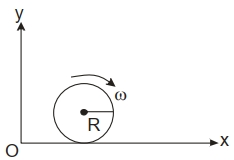
A spherical shell of $1 \,kg$ mass and radius $R$ is rolling with angular speed $\omega$ on horizontal plane (as shown in figure). The magnitude of angular momentum of the shell about the origin $O$ is $\frac{a}{3} R^{2} \omega$. The value of a will be ..............
A particle starting from rest, moves in a circle of radius $r$. It attains a velocity of $\mathrm{V}_{0} \;\mathrm{m} / \mathrm{s}$ in the $\mathrm{n}^{\text {th }}$ round. Its angular acceleration will be
Which one of the following is not used to reduce friction