Question
An optical instrument used for angular magnification has a 25D objective and a 20D eyepiece. The tube length is 25cm when the eye is least strained.
  1. Whether it is a microscope or a telescope?
  2. What is the angular magnification produced?

Answer

The optical instrument has

$\text{f}_0=\frac{1}{25\text{D}}=0.04\text{m}=4\text{cm}$

$\text{f}_\text{e}=\frac{1}{20\text{D}}=0.05\text{m}=5\text{cm}$

tube length = 25cm (normal adjustment)

  1. The instrument must be a microscope as f0 < fe
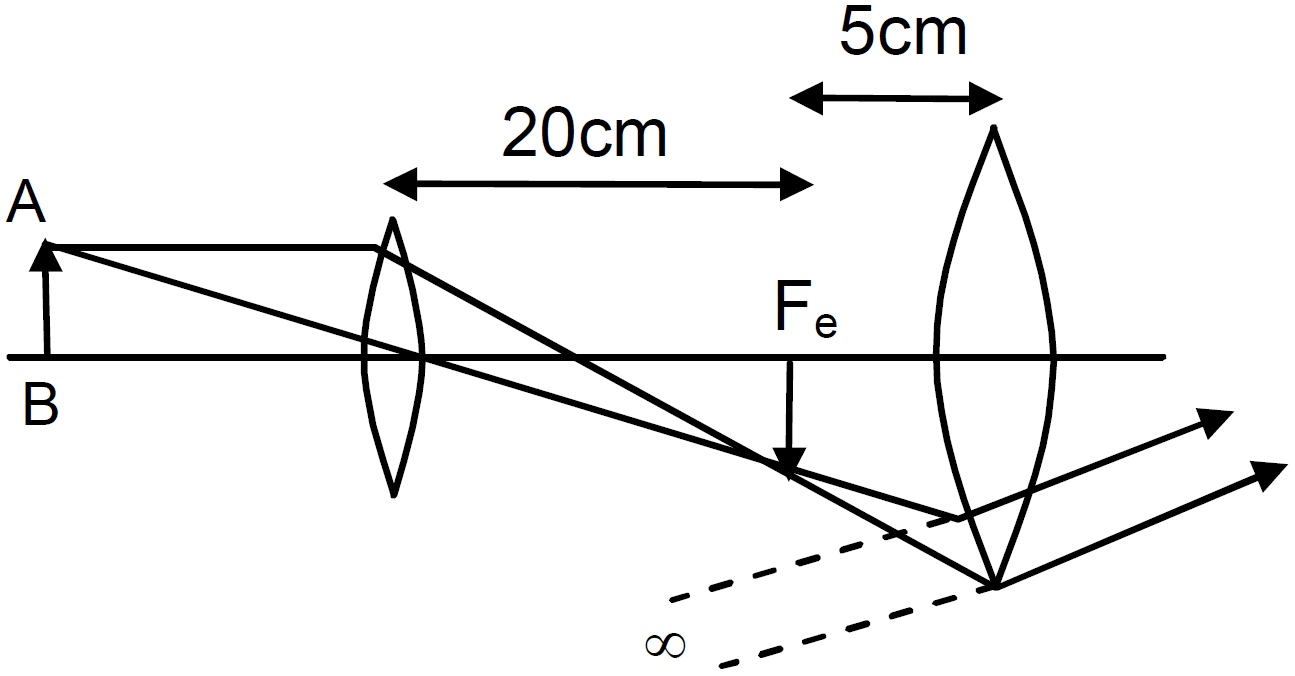
  2. Since the final image is formed at infinity, the image produced by the objective should lie on the focal plane of the eye piece.

So, image distance for objective = v0 = 25 – 5 = 20cm

Now, using lens formula.

$\frac{1}{\text{v}_0}-\frac{1}{\text{u}_0}=\frac{1}{\text{f}_0}$

$\Rightarrow\frac{1}{\text{u}_0}=\frac{1}{\text{v}_0}-\frac{1}{\text{f}_0}=\frac{1}{20}-\frac{1}{4}$

$=\frac{-4}{20}=\frac{-1}{5}\Rightarrow\text{u}_0=-5\text{cm}$

So, angular magnification $\text{m}=-\frac{\text{v}_0}{\text{u}_0}\times\frac{\text{D}}{\text{f}_\text{e}}$[Taking D = 25cm]

$=-\frac{20}{-5}\times\frac{25}{5}=20$
Need a full question paper?

Generate a complete, print-ready paper with questions like this in minutes — across 16+ boards, with answer keys.

Start Generating Free

Similar questions

An infinite ladder is constructed with $1\Omega$ and $2\Omega$ resistors, as shown in the figure.

(a) Find the effective resistance between the points A and B. (b) Find the current that passes through the $2\Omega$ resistor nearest to the battery.

A square loop of side 12cm with its sides parallel to X and Y axes is moved with a velocity of 8cms–1 in the positive x-direction in an environment containing a magnetic field in the positive z-direction. The field is neither uniform in space nor constant in time. It has a gradient of 10–3T cm–1 along the negative x-direction (that is it increases by 10–3T cm–1 as one moves in the negative x-direction), and it is decreasing in time at the rate of 10 –3T s–1. Determine the direction and magnitude of the induced current in the loop if its resistance is 4.50 mΩ.
Two point charges of magnitude +q and -q are placed at $\Big(-\frac{\text{d}}{2},0,0\Big)$ and $\Big(\frac{\text{d}}{2},0,0\Big)$, respectively. Find the equation of the equipoential surface where the potential is zero.
A torsional pendulum consists of a solid disc connected to a thin wire$\Big(\alpha=2.4\times10^{-5}\ ^\circ\text{C}^{-1}\Big)$at its centre. Find the percentage change in the time period between peak winter (5°C) and peak summer (45°C).
Suppose there is a circuit consisting of only resistances and batteries. Suppose one is to double (or increase it to n-times) all voltages and all resistances. Show that currents are unaltered.
238U decays to 206Pb with a half-life of 4.47 × 10⁹y. This happens in a number of steps. Can you justify a single half for this chain of processes? A sample of rock is found to contain 2.00mg of 238U and 0.600mg of 206Pb. Assuming that all the lead has come from uranium, find the life of the rock.
Two particles A and B, each having a charge Q, are placed a distance d apart. Where should a particle of charge q be placed on the perpendicular bisector of AB so that it experiences maximum force What is the magnitude of this maximum force?
Derive an expression for the electric potential at a point due to an electric dipole. Mention the contrasting features of electric potential of a dipole at a point as compared to that due to a single charge.
Define magnetic permeability and magnetic susceptibility. Prove that $\mu_{r} = (1+\chi)$.
In a plane electromagnetic wave, the electric field oscillates sinusoidally at a frequency of 2.0 × 10¹⁰ Hz and amplitude 48 V m-1.
  1. What is the wavelength of the wave?
  2. What is the amplitude of the oscillating magnetic field?
  3. Show that the average energy density of the E field equals the average energy density of the B field. [c = 3 × 10⁸ m s-1.]