Question
Define magnetic permeability and magnetic susceptibility. Prove that $\mu_{r} = (1+\chi)$.
Answer

Magnetic Permeability : It is the ability of a material to permit the passage of magnetic field lines through it. Hence it is the degree to which the magnetic field can penetrate the material.
For example, when a piece of iron is placed in a magnetising field, lines of force become much more concentrated in iron (where they become lines of induction) than in air. Thus iron is said to have greater permeability than air. The permeability of a medium may be defined as ratio of the lines of induction per unit normal area to the number of lines of force of the magnetising field per unit normal area. The former measures the magnetic induction B in the medium and the latter measures the strength of the magnetising field H. Hence permeability µ is defined as the ratio of the magnetising induction (B) in the specimen to the magnetising field (H). Thus $\mu=\frac{B}{H}$.
The ratio of magnetic permeability of the material $\mu$ and magnetic permeability of free space $\left(\mu_0\right)$ is called relative permeability of the substance denoted by $\mu_r$ i.e. $\mu_r=\mu / \mu_0$.
where $\mu_0 \times 4 \pi \times 10^{-7} Wb / Am$
Magnetic Susceptibility : For a large number of magnetic materials the intensity of magnetisation I is proportional to magnetising field strength, H. i.e.
$I \propto H$ or $I=\chi . H$
Where $\chi$ is a proportionality constant and is known as magnetic susceptibility of magnetic material.
Now $I =\chi H \Rightarrow \chi= I / H$
Hence the magnetisation per unit field strength is called the magnetic susceptibility.
Since I and H have the same dimensions the quantity $\chi$ is dimensionless i.e. it has no unit.
The magnetic susceptibility of a specimen of a magnetic material measures the ease with which the specimen can be magnetised. Since I is equal to the magnetic moment per unit volume, hence the susceptibility as defined above is also called volume susceptibility of the material.
Derivation of $\mu _r=(1+\chi)$ : When a magnetic material is placed in a magnetising field of magnetic intensity $\overrightarrow{ H }$, the material gets magnetised. In this state the total magnetic induction $\overrightarrow{ B }$ is the sum of the magnetic induction $\overrightarrow{ B }_0$ in vaccum produced by the magnetic intensity $\overrightarrow{ H }$ and magnetic induction $\overrightarrow{ B }_m$ due to magnetisation of the material i.e. intensity of magnetisation.
Hence $\overrightarrow{ B }=\overrightarrow{ B }_0+\overrightarrow{ B }_m$
but $\overrightarrow{ B }=\mu \overrightarrow{ H }, B _0=\mu_0 \overrightarrow{ H }$ and $\overrightarrow{ B }_m=\mu_0 \overrightarrow{ I }$
$\mu H =\mu_0( H + I )$
$\Rightarrow \quad \mu H =\mu_0 H \left(1+\frac{ I }{ H }\right)$
$\Rightarrow \quad \frac{\mu}{\mu_0}=\left(1+\frac{ I }{ H }\right)$. But $\mu / \mu_0=\mu_r$ and $I / H =\chi$
$\therefore \quad \mu_r=(1+\chi)$

Need a full question paper?

Generate a complete, print-ready paper with questions like this in minutes — across 16+ boards, with answer keys.

Start Generating Free

Similar questions

  1. With the help of the circuit diagram explain the working principle of a transistor amplifier as an oscillator.
  2. Distinguish between a conductor, a semiconductor and an insulator on the basis of energy band diagrams.
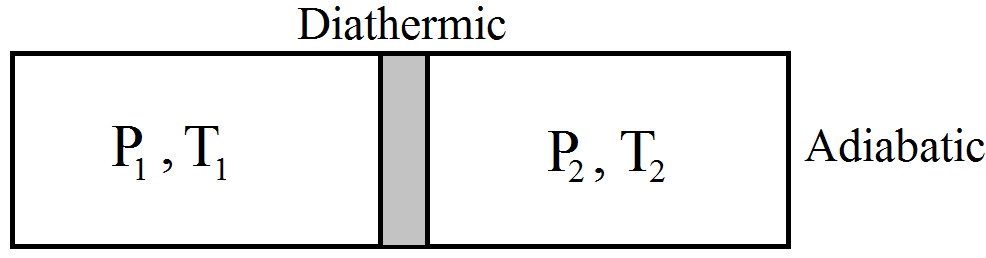
Figure. shows a cylindrical tube of volume V with adiabatic walls containing an ideal gas. The internal energy of this ideal gas is given by 1.5nRT. The tube is divided into two equal parts by a fixed diathermic wall. Initially, the pressure and the temperature are P1, T1 on the left and p2, T2 on the right. The system is left for sufficient time so that the temperature becomes equal on the two sides.

  1. How much work has been done by the gas on the left part?
  2. Find the final pressures on the two sides.
  3. Find the final equilibrium temperature.
  4. How much heat has flown from the gas on the right to the gas on theleft?
A copper wire of radius 0.1mm and resistance $1\text{k}\Omega$ is connected across a power supply of 20V.
(a) How many electrons are transferred per second between the supply and the wire at one end? (b) Write down the current density in the wire.
One end of a 10cm long silk thread is fixed to a large vertical surface of a charged nonconducting plate and the other end is fastened to a small ball having a mass of 10g and a charge of 4.0 × 10⁻⁵C. In equilibrium, the thread makes an angle of 60° with the vertical. Find the surface charge density on the plate.
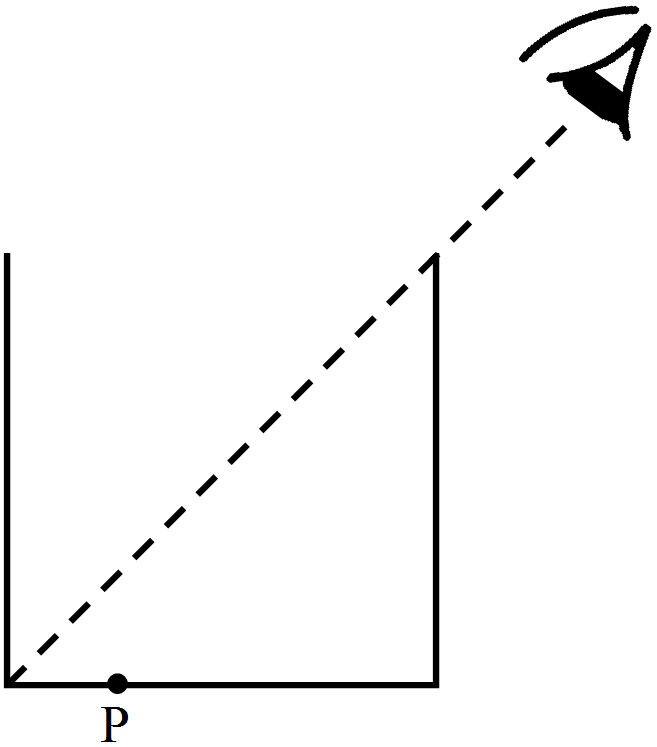
A cylindrical vessel, whose diameter and height both are equal to 30cm, is placed on a horizontal surface and a small particle P is placed in it at a distance of 5.0cm from the centre. An eye is placed at a position such that the edge of the bottom is just visible. The particle P is in the plane of drawing. Up to what minimum height should water be poured in the vessel to make the particle P visible?

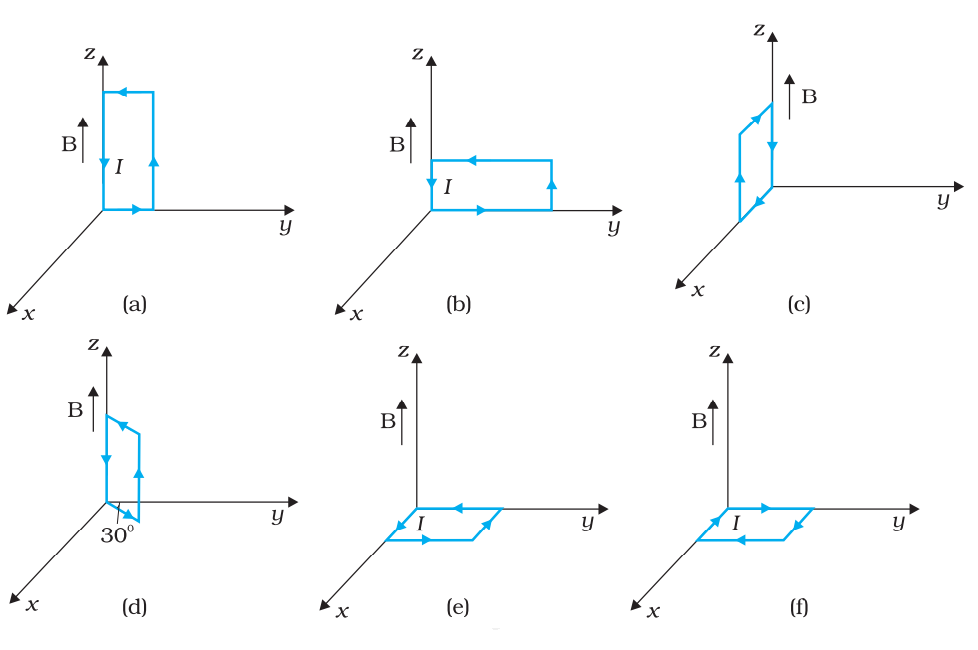
A uniform magnetic field of 3000 G is established along the positive z-direction. A rectangular loop of sides 10 cm and 5 cm carries a current of 12 A. What is the torque on the loop in the different cases shown in Fig.? What is the force on each case? Which case corresponds to stable equilibrium?

A spherical ball A of surface area 20cm2 is kept at the centre of a hollow spherical shell B of area 80cm2. The surface of A and the inner surface of B emit as blackbodies. Both A and B are at 300K.
  1. How much is the radiation energy emitted per second by the ball A?
  2. How much is the radiation energy emitted per second by the inner surface of B
  3. How much of the energy emitted by the inner surface of B falls back on this surface itself?
If the tension in the cable supporting an elevator is equal to the weight of the elevator, the elevator may be:
  1. Going up with increasing speed.
  2. Going down with increasing speed.
  3. Going up with uniform speed.
  4. Going down with uniform speed.
Describe the principle and working of a cyclotron with proper diagram. Give the expression of cyclotron frequency and kinetic energy of the particle regarding cyclotron.
A capacitor of capacitance $10\mu\text{F}$ is connected to a battery of emf 2V. It is found that it takes 50ms for the charge of the capacitor to become $12.6\mu\text{C}.$ Find the resistance of the circuit.