Question
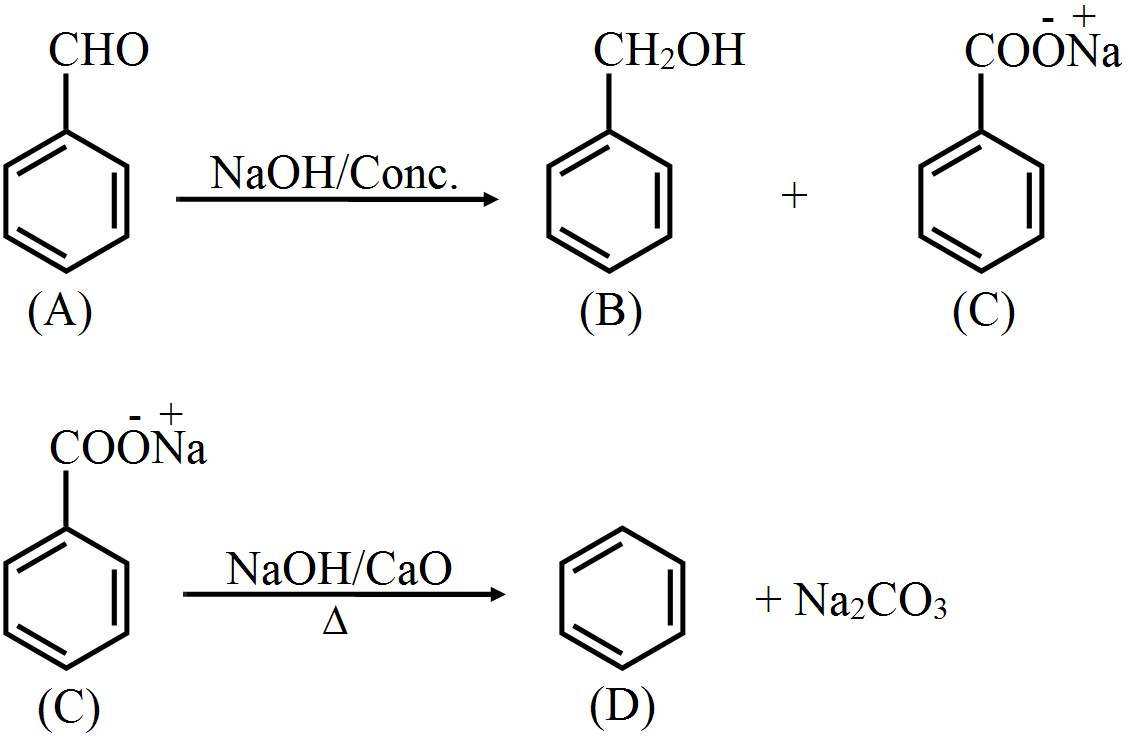
An organic compound (A) has characteristic odour. On treatment with NaOH, it forms compounds (B) and (C). Compound (B) has molecular formula $C_7H_8O$ which on oxidation gives back (A). The compound (C) is a sodium salt of an acid. When (C) is treated with soda-lime, it yields an aromatic compound (D). Deduce the structures of (A), (B), (C) and (D). Write the sequence of reactions involved.
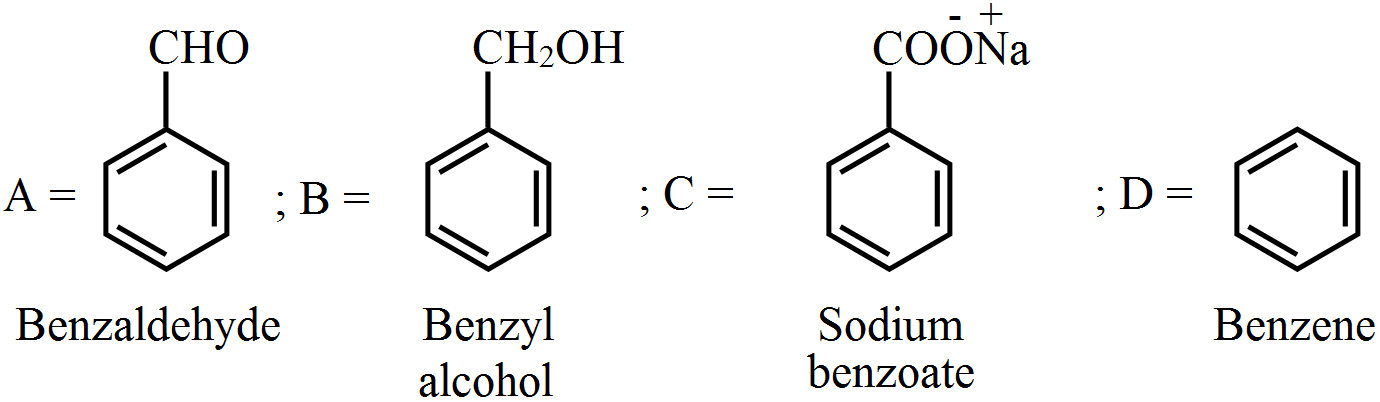
Answer


Reaction involved are:

Need a full question paper?

Generate a complete, print-ready paper with questions like this in minutes — across 16+ boards, with answer keys.

Start Generating Free

Similar questions

What will be the amount of $H_2$ liberated at the cathode when a current of $1$ ampere is passed for $3000$ second in water acidified with $ \text{HCl}$ ?
Write equations of the following reactions:
  1. Acetylation of aniline
  2. Coupling reaction
  3. Carbyl amine reaction
State Kohlrausch's law of independent migration of ions. How can the degree of dissociation of acetic acid in a solution be calculated from its molar conductivity data?
Write IUPAC names of the following coordination compounds:
  1. $K_3[Fe(C_2O_4)_3]$
  2. $K_2[PdCl_4]$
Complete the following giving the structures of major organic products.
$(\text{CH}_3)_3-\text{C}-\text{CH}_2-\text{Br}\xrightarrow[\Delta]{\text{C}_2\text{H}_5\text{ONa}/\text{C}_2\text{H}_5\text{OH}}\ ........$
How would you account for the following?
i. The atomic radii of the metals of the third (5d) series of transition elements are virtually the same as those of the corresponding members of the second (4d) series.
ii. The $E ^{\circ}$ value for the $Mn ^{3+} / Mn ^{2+}$ couple is much more positive than that for $Cr ^{3+} / Cr ^{2+}$ couple or $Fe ^{3+} / Fe ^{2+}$ couple.
iii. The highest oxidation state of a metal is exhibited in its oxide or fluoride.
Write the IUPAC name of the ionisation isomer of the coordination compound $[Co(NH_{3)5}Br]SO_4$. Give one chemical test to distinguish between the two compounds.
Define the term solution. How many types of solutions are formed? Write briefly about each type with an example.
$SF_6$ is known but $SCl_6$ is not. Why?
Discuss structure of the carbonyl group.