An oscillator of mass $M$ is at rest in its equilibrium position in a potential $V\, = \,\frac{1}{2}\,k{(x - X)^2}.$ A particle of mass $m$ comes from right with speed $u$ and collides completely inelastically with $M$ and sticks to it . This process repeats every time the oscillator crosses its equilibrium position .The amplitude of oscillations after $13$ collisions is: $(M = 10,\, m = 5,\, u = 1,\, k = 1 ).$
JEE MAIN 2018, Diffcult
Download our app for free and get started
In first collision $mu$ momentum will be imparted to system, in second collision when momentum of $(\mathrm{M}+\mathrm{m})$ is in opposite direction $mu$ momentum of particle will make its momentum zero.
On $13^{\text {th }}$ collision,
$\mathrm{m} \rightarrow {\mathrm{M}+12} ; \quad \mathrm{M}+13 \mathrm{m} \rightarrow \mathrm{V}$
$\mathrm{mu}=(\mathrm{M}+13 \mathrm{m}) \mathrm{v} \Rightarrow \mathrm{v}=\frac{\mathrm{mu}}{\mathrm{M}+13 \mathrm{m}}=\frac{\mathrm{u}}{15}$
$v=\omega A \Rightarrow \frac{u}{15}=\sqrt{\frac{K}{M-13 m}} \times A$
Putting value of $M, m, u$ and $K$ we get amplitude
$A=\frac{1}{15} \sqrt{\frac{75}{1}}=\frac{1}{\sqrt{3}}$

Download our appand get started for free
Experience the future of education. Simply download our apps or reach out to us for more information. Let's shape the future of learning together!No signup needed.*
Similar Questions
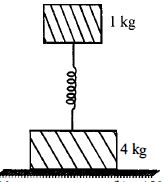
- 1Two bodies of masses $1\, kg$ and $4\, kg$ are connected to a vertical spring, as shown in the figure. The smaller mass executes simple harmonic motion of angular frequency $25\, rad/s$, and amplitude $1.6\, cm$ while the bigger mass remains stationary on the ground. The maximum force exerted by the system on the floor is ..... $N$ ( take $g = 10\, ms^{-2}$)View Solution
- 2A mass $m$ attached to free end of a spring executes SHM with a period of $1\; s$. If the mass is increased by $3\; kg$ the period of oscillation increases by one second, the value of mass $m$ is $..............kg$.View Solution
- 3The displacement of a particle from its mean position (in metre) is given by $y = 0.2\sin (10\pi t + 1.5\pi )\cos (10\pi t + 1.5\pi )$. The motion of particle isView Solution
- 4A particle executes $S.H.M.$ and its position varies with time as $x=A$ sin $\omega t$. Its average speed during its motion from mean position to mid-point of mean and extreme position isView Solution
- 5A particle executes simple harmonic motion between $x =- A$ and $x =+ A$. If time taken by particle to go from $x=0$ to $\frac{A}{2}$ is $2 s$; then time taken by particle in going from $x =\frac{ A }{2}$ to $A$ is $.........\,s$View Solution
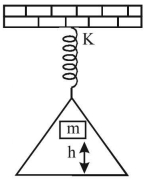
- 6A load of mass $m$ falls from a height $h$ on to the scale pan hung from the spring as shown in the figure. If the spring constant is $k$ and mass of the scale pan is zero and the mass $m$ does not bounce relative to the pan, then the amplitude of vibration isView Solution
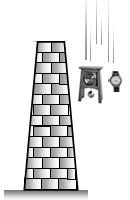
- 7A man having a wrist watch and a pendulum clock rises on a $TV$ tower. The wrist watch and pendulum clock per chance fall from the top of the tower. ThenView Solution
- 8Average velocity of a particle executing $SHM$ in one complete vibration isView Solution
- 9Length of a simple pendulum is $l$ and its maximum angular displacement is $\theta$, then its maximum $K.E.$ isView Solution
- 10The total energy of a particle executing $S.H.M.$ is $80 \,J$. What is the potential energy when the particle is at a distance of $\frac{3}{4}$ of amplitude from the mean position..... $J$View Solution