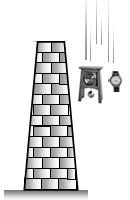
A man having a wrist watch and a pendulum clock rises on a $TV$ tower. The wrist watch and pendulum clock per chance fall from the top of the tower. Then
Easy


Download our appand get started for free
Experience the future of education. Simply download our apps or reach out to us for more information. Let's shape the future of learning together!No signup needed.*
Similar Questions
- 1A $LCR$ circuit behaves like a damped harmonic oscillator. Comparing it with a physical springmass damped oscillator having damping constant $\mathrm{b}$, the correct equivalence would be:View Solution
- 2Two simple harmonic motions are represented by equations ${y_1} = 4\,\sin \,\left( {10t + \phi } \right)$ and ${y_2} = 5\,\cos \,10\,t$ What is the phase difference between their velocities?View Solution
- 3The displacement of a damped harmonic oscillator is given by $x\left( t \right) = {e^{ - 0.1\,t}}\,\cos \left( {10\pi t + \varphi } \right)$ The time taken for its amplitude of vibration to drop to half of its initial value is close to .... $s$View Solution
- 4View SolutionTwo mutually perpendicular simple harmonic vibrations have same amplitude, frequency and phase. When they superimpose, the resultant form of vibration will be
- 5A pendulum has time period $T$. If it is taken on to another planet having acceleration due to gravity half and mass $ 9 $ times that of the earth then its time period on the other planet will beView Solution
- 6A $0.10\, kg$ block oscillates back and forth along a horizontal surface. Its displacement from the origin is given by: $x = (10\,cm)\cos [(10\,rad/s)\,t + \pi /2\,rad]$. What is the maximum acceleration experienced by the blockView Solution
- 7A simple pendulum is suspended from the roof of a trolley which moves in a horizontal direction with an acceleration $a$, then the time period is given by $T = 2\pi \sqrt {\frac{l}{{g'}}} $, where $g'$ is equal toView Solution
- 8A particle executes simple harmonic motion with an amplitude of $5\, cm$. When the particle is at $4\, cm$ from the mean position, the magnitude of its velocity is $SI\,units$ is equal to that of its acceleration. Then, its periodic time in seconds isView Solution
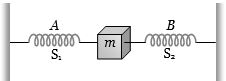
- 9In the figure, ${S_1}$ and ${S_2}$ are identical springs. The oscillation frequency of the mass $m$ is $f$. If one spring is removed, the frequency will becomeView Solution
- 10The displacement of a particle varies according to the relation $x = 3 \ sin\ 100t + 8\ cos^2\ 50t$ . Which of the following is incorrect about this motionView Solution