MCQ
An $X-$ ray machine has an accelerating potential difference of $25,000$ volts. By calculation the shortest wavelength will be obtained as.......$\mathop A\limits^o $ ($h = 6.62 \times {10^{ - 34}}$ J-sec; e = $1.6 \times {10^{ - 19}}$coulomb)
  • A
    $0.25$
  • $0.50 $
  • C
    $1$
  • D
    $2.50$

Answer

Correct option: B.
$0.50 $
b
(b) ${\lambda _{\min }} = \frac{{hc}}{{eV}} = \frac{{12375}}{V}\,{Å}$ $ = 0.495\,\,{Å} \approx 0.5\,{Å}$

Need a full question paper?

Generate a complete, print-ready paper with questions like this in minutes — across 16+ boards, with answer keys.

Start Generating Free

Similar questions

Two tangent galvanometer coils of same radius connected in series. The current flowing produces deflection of $60^o$ and $45^o$. The ratio of number of turns in coil is
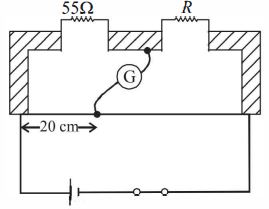
Shown in the figure below is a meter-bridge set up with null deflection in the galvanometer. The value of the unknown resistor $R$ is ............. $\Omega$
An electron, moving in a uniform magnetic field of induction of intensity $\vec B,$ has its radius directly proportional to
An arbitrary shaped closed coil is made of a wire of length $L$ and a current $I$ ampere is flowing in it. If the plane of the coil is perpendicular to magnetic field $\mathop B\limits^ \to $, the force on the coil is
A cell of negligible resistance and e.m.f. 2 volts is connected to series combination of 2, 3 and 5 ohm. The potential difference in volts between the terminals of 3 ohm resistance will be
A force of $10 \; N$ acts on a charged particle placed between two plates of a charged capacitor. If one plate of capacitor is removed, then the force acting on that particle will be ...... $N$
If a charged particle is projected perpendicular to a uniform magnetic field, then:
  1. It revolves in circular path
  2. Its $K.E.$ remains constant
  3. Its momentum remains constant
  4. Its path is spiral
In a Young's double slit experiment, the source is white light. One of the holes is covered by a red filter and another by a blue filter. In this case:
A particle of mass $m$ and charge $q$ moving with velocity $v$ enters a region of uniform magnetic field $B.$ Then
A particle of specific charge (charge/mass) $\alpha$ starts moving from the origin under the action of an electric field $\vec E = {E_0}\hat i$ and magnetic field $\vec B = {B_0}\hat k$. Its velocity at $(x_0 , y_0 , 0)$ is ($(4\hat i + 3\hat j)$ . The value of $x_0$ is: