Question
"Analysis of age-pyramids for human population can provide important inputs for long-term planning strategies." Explain.
Answer

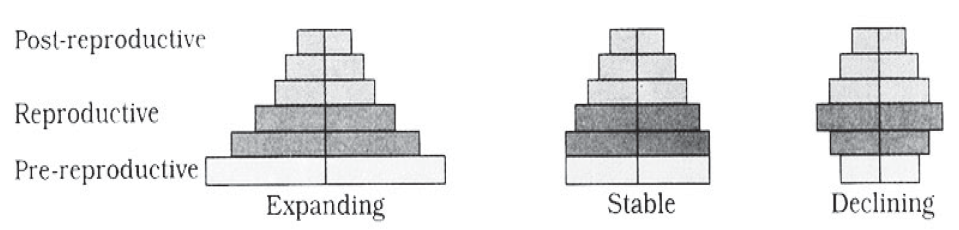
Age pyramids show age distribution of males and females in a combined diagram.
The shape of the pyramid reflects the growth status of the population whether it is growing or stable or declining.
Pyramids also indicate the ratio of pre-reproductive, reproductive and post-reproductive individuals in a population.
//

Planning of health/education/transport/infrastructure/finance/food/employment can depend on the age-pyramid analysis of a population.

Need a full question paper?

Generate a complete, print-ready paper with questions like this in minutes — across 16+ boards, with answer keys.

Start Generating Free

Similar questions

Read the following and answer any four questions from (i) to (v) given below:

Plants having foreign genes in their genome through genetic engineering are called transgenic plants. Genes can be incorporated either through a vector or through direct introduction of DNA. Bt cotton is a genetically modified organism which is pest resistant. It contain gene cry I Ac and cry II Ab of Bacillus thuringiensis. It is used to control lepidopterans, coleopterans and dipterans. Bt cotton can resist cotton bollworm and produce higher yields. Cry gene produces cry protein or Bt toxin. It is an endotoxin which remains as protoxin in plants and converted to active toxin after getting ingested by the insects. Alkaline pH of the insect gut solubilises the protein crystals, the activated toxin creates pores to the mid guts wall of the insects which cause them to death.

  1. Bt cotton crops are:
  1. Fungal resistant.
  2. Insect resistant.
  3. Drought resistant.
  4. All of these.
  1. Cotton bollwonns are killed by the protein encoded by the gene:
  1. cry I Ac
  2. cry I Ab
  3. cry I Ab
  4. Both (a) and (c).
  1. Which of the following is not an advantage of GM crops?
  1. GM plants enhance nutritional value of food.
  2. GM plants are more tolerant to abiotic stresses.
  3. GM plants have helped to reduce post harvest losses.
  4. GM plants can cause gene transfer to non-target plant species.
  1. Bacillus thuringiensis is a:
  1. Air borne bacteria.
  2. Soil borne bacteria.
  3. Soil borne fungus.
  4. Food borne bacteria.
  1. Assertion: Cotton bollworms are killed by ingesting the leaves of the transgenic plant.

Reason: Bt toxin binds with the midgut wall of the insect and make pores in them.

  1. Both assertion and reason are true and reason is the correct explanation of assertion.
  2. Both assertion and reason are true but reason is not the correct explanation of assertion.
  3. Assertion is true but reason is false.
  4. Both assertion and reason are false.
Study the flow chart given below and answer the questions that follow:
  1. S strain into mice mice die.
  2. R strain into mice → mice live.
  3. Heat killed S strain + live R strain into mice → A
  4. Heat killed S strain + DNase + live R strain → into mice B
  1. Name the organism and differentiate between its two strains, R and S, respectively.
  2. Write the results A and B obtained in steps (e) and (d), respectively.
  3. Name the Scientist who performed the steps (a), (b) and (c).
  4. Write the specific conclusion drawn from the step (d).
Explain the process of transcription in a prokaryote.

OR

 Describe the process of transcription in a bacterium.

Describe the functions of the following:
Epididymis.
  1. What is hydrarch succession?
  2. Compare the pioneer species and climax communities of hydrarch and xerarch succession respectively.
  3. List the factors upon which the type of invading pioneer species depend in secondary hydrarch succession. Why is the rate of this succession faster than that of primary succession?
Write an essay on Darwinism.
OR
What do you understand by Darwinism? Describe in detail.
OR
Discuss various steps explaining the detail mechanism of natural selection theory given by Darwin.
  1. With labelled diagrams, depict stages in embryo development in a dicotyledonous plant.
  2. Endosperm development precedes embryo development. Why?
How is the phenotypic ratio of F2 generation different in a dihybrid cross?
What are hallucinogens? Give two examples. Mention their clinical use, if
any.
State the three principles of Mendel’s law of inheritance.