Question
Study the flow chart given below and answer the questions that follow:
  1. S strain into mice mice die.
  2. R strain into mice → mice live.
  3. Heat killed S strain + live R strain into mice → A
  4. Heat killed S strain + DNase + live R strain → into mice B
  1. Name the organism and differentiate between its two strains, R and S, respectively.
  2. Write the results A and B obtained in steps (e) and (d), respectively.
  3. Name the Scientist who performed the steps (a), (b) and (c).
  4. Write the specific conclusion drawn from the step (d).
Answer

  1. Streptococcus pneumoniae:
  1. R-cells are those cells that form rough colonies, without a capsule and are non-virulent, i.e., they did not cause pneumonia.
  2. S-cells are those cells that form smooth colonies, protected by a capsule and are virulent, i.e., they caused the disease, pneumonia.
  3. He showed that DNA is the transforming principle.
  1. A. Mice died of pneumonia. B. Mice lived and did not suffer from pneumonia.
  2. Frederick Griffith performed the steps (a), (b) and (c).
  3. This indicates that DNA is the transforming principle.

When DNase is added to the medium, the DNA of the heat-killed cells gets digested and is unable to carry out the transformation.

Need a full question paper?

Generate a complete, print-ready paper with questions like this in minutes — across 16+ boards, with answer keys.

Start Generating Free

Similar questions

Fill in the blanks,
Species A
Species B
Type of Interaction
Example
+
+
+
-
+
_____
_____
_____
Commensalism
_____
_____
_____
Angiosperm flowers may be monoecious, cleistogamous or show self-incompatibility. Describe the characteristic features of each one of them and state which one of these flowers promotes inbreeding and outbreeding respectively.
Find out from newspapers and popular science articles any new fossil discoveries or controversies about evolution.
A person in your colony has recently been diagnosed with AIDS. People/residents in the colony want him to leave the colony for the fear of spread of AIDS.
  1. Write your view on the situation, giving reasons.
  2. List the possible preventive measures that you would suggest to the residents of your locality in a meeting organised by you so that they understand the situation.
  3. Write the symptoms and the causative agent of AIDS.
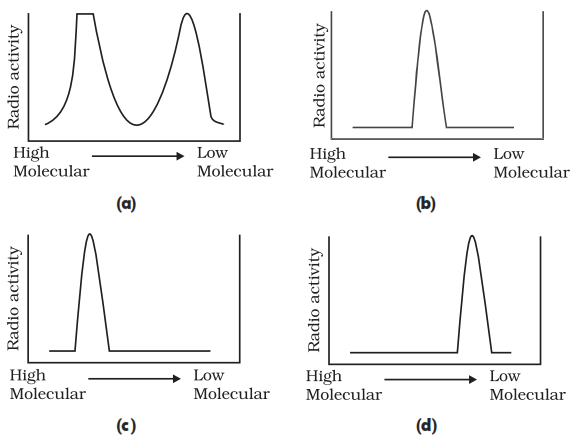
Replication was allowed to take place in the presence of radioactive deoxynucleotides precursors in E.coli that was a mutant for DNA ligase. Newly synthesised radioactive DNA was purified and strands were separated by denaturation. These were centrifuged using density gradient centrifugation. Which of the following would be a correct result?

  1. Draw a diagram of a mature embryo sac of an angiosperm and label the following parts in it:
  1. Filiform apparatus.
  2. Synergids.
  3. Central cell.
  4. Egg cell.
  5. Polar nuclei.
  6. Antipodals.
  1. Write the fate of egg cell and polar nuclei after fertilisation.
What is the inheritance pattern observed in the size of starch grains and seed shape of Pisum sativum? Workout the monohybrid cross showing the above traits. How does this pattern of inheritance deviate from that of Mendelian law of dominance?
What is an ecosystem service? List any four important ecosystem services provided by the natural ecosystems. Are you in favour or against levying a charge on the service provided by the ecosystem?
Explain the difference between prokaryotic and eukaryotic DNA.
Trace the events taking place in a flower from the time of pollen grain entry up to the completion of fertilisation.