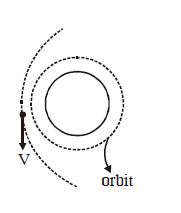
MCQ
Angular momentum of the particle rotating with a central force is constant due to
  • A
    constant torque
  • B
    constant force
  • C
    constant linear momentum
  • zero torque

Answer

Correct option: D.
zero torque
d
We known that $\overrightarrow {{\tau _c}}  = \frac{{\overrightarrow {d{L_c}} }}{{dt}}$

Where $\overrightarrow {{\tau _c}} $ torque about the center of mass of the body and $\overrightarrow {{L_c}} $ $=$ Angula momentum about the center of mass of the body. central forces act along the center of mass. Therefore torque about center of mass is zero.

When $\overrightarrow {{\tau _c}} $ $= 0$    then $\overrightarrow {{L_c}} $ $=$ constt.

Need a full question paper?

Generate a complete, print-ready paper with questions like this in minutes — across 16+ boards, with answer keys.
Start Generating Free

Similar questions

The heat capacity of one mole an ideal is found to be $C_V=3 R(1+a R T) / 2$, where $a$ is a constant. The equation obeyed by this gas during a reversible adiabatic expansion is
If ${E}$ and ${H}$ represents the intensity of electric field and magnetising field respectively, then the unit of $E/H$ will be :
A ball is thrown vertically upwards from the ground $G$ with a speed $u$. It reaches a point $B$ at a height $h$ (lower than the maximum height) after time $t_1$. It returns to the ground after time $t_2$ from the instant it was at $B$ during the upward journey. Then $t_1t_2$ is equal to
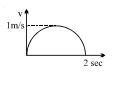
Velocity-time graph for a car is semicircle as shown here. Which of the following is correct :
It takes one minute for a passenger standing on an escalator to reach the top. If the escalator does not move it takes him $3$ minute to walk up . ....... $\sec$ long will it take for the passenger to arrive at the top if he walks up the moving escalator ?
Heat is flowing through a conductor of length l from $x = 0$ to $x = l$ . If its thermal resistance per unit length is uniform, which of the following graphs is correct
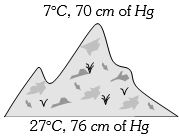
At the top of a mountain a thermometer reads $7°C$ and a barometer reads $70\, cm$ of $Hg.$ At the bottom of the mountain these read $27°C$ and $76 \,cm$ of $Hg$ respectively. Comparison of density of air at the top with that of bottom is
A linear harmonic oscillator of force constant $2 \times 10^6\,Nm^{-1}$ and amplitude $0.01\, m$ has a total mechanical energy of $160\, J.$ Its
A transverse wave propagating along X-axis is represented by
$\text{y (x, t)}=8.0\sin(0.5\pi\text{x}-4\pi\text{t}-\frac{\pi}{4})$
where x is in metre and t is in seconds. The speed of the wave is:
A spaceship approaches the moon (mass $= M$ ) and radius $(R)$ along a parabolic path which almost tangential to its surface. At the moment of maximum approach, the brake rocket is fired to convert the spaceship into a satellite of the moon. Find change in speed