Question
Answer the following:
A man fixes outside his house one evening a two metre high insulating slab carrying on its top a large aluminium sheet of area $1m^2.$ Will he get an electric shock if he touches the metal sheet next morning?
Answer

Yes, the man will get an electric shock if he touches the metal slab next morning. The steady discharging current in the atmosphere charges up the alurnlniurn sheet. As a result, its voltage rises gradually. The raise in the voltage depends on the capacitance of the capacitor formed by the aluminium slab and the ground.

Need a full question paper?

Generate a complete, print-ready paper with questions like this in minutes — across 16+ boards, with answer keys.

Start Generating Free

Similar questions

State Bohr's quantization condition of angular momentum. Calculate the shortest wavelength of the Bracket series and state to which part of the electromagnetic spectrum does it belong.
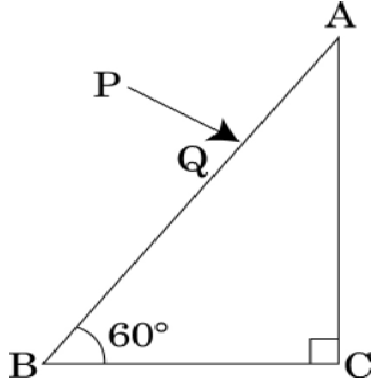
A ray PQ incident normally on the refracting face BA is refracting in the prism BAC made of material of refractive index1.5. Complete the path of ray through the prism. From which face will the ray emerge? Justify your answer.
Why is a white dress more comfortable than a dark dress in summer?
Explain the Construction and working of gold leaf electroscope.
In questions 7.3 and 7.4, what is the net power absorbed by each circuit over a complete cycle? Explain your answer.
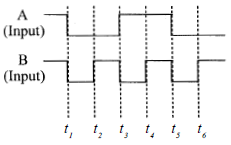
The given inputs A, B are fed to a 2-input NAND gate. Draw the output wave form of the gate. 
On the basis of energy band theory, write the difference between conductor, insulator and semiconductor.
A boy standing on a long railroad car throws a ball straight upwards. The car is moving on the horizontal road with an acceleration of $1m/s^2$ and the projection velocity in the vertical direction is $9.8m/s$. How far behind the boy will the ball fall on the car?
Find the greatest length of an organ pipe open at both ends that will have its fundamental frequency in the normal hearing range (20Hz-20,000Hz). Speed of sound in air = 340m/s.
The 200m free style women's swimming gold medal at Seol Olympic 1988 went to Heike Friendrich of East Germany when she set a new Olympic record of 1 minute and 57.56 seconds. Assume that she covered most of the distance with a uniform speed and had to exert 460W to maintain her speed. Calculate the average force of resistance offered by the water during the swim.