MCQ
Answer the following by appropriately matching the lists based on the information given in the paragraph.

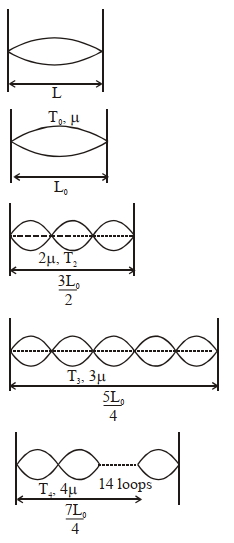
A musical instrument is made using four different metal strings, $1,2,3$ and $4$ with mass per unit length $\mu, 2 \mu, 3 \mu$ and $4 \mu$ respectively. The instrument is played by vibrating the strings by varying the free length in between the range $L _0$ and $2 L _0$. It is found that in string-$1$ $(\mu)$ at free length $L _0$ and tension $T _0$ the fundamental mode frequency is $f _0$.

$List-I$ gives the above four strings while $list-II$ lists the magnitude of some quantity.

$List-I$ $List-II$
$(I)$ String-1( $\mu$ ) $(P) 1$
$(II)$ String-2 $(2 \mu)$ $(Q)$ $1 / 2$
$(III)$ String-3 $(3 \mu)$ $(R)$ $1 / \sqrt{2}$
$(IV)$ String-4 $(4 \mu)$ $(S)$ $1 / \sqrt{3}$
  $(T)$ $3 / 16$
  $(U)$ $1 / 16$

($1$) If the tension in each string is $T _0$, the correct match for the highest fundamental frequency in $f _0$ units will be,

$(1)$ $I \rightarrow P , II \rightarrow R , III \rightarrow S , IV \rightarrow Q$

$(2)$ $I \rightarrow P , II \rightarrow Q , III \rightarrow T , IV \rightarrow S$

$(3)$ $I \rightarrow Q , II \rightarrow S , III \rightarrow R , IV \rightarrow P$

$(4)$ I $\rightarrow Q , II \rightarrow P , III \rightarrow R$, IV $\rightarrow T$

($2$) The length of the string $1,2,3$ and 4 are kept fixed at $L _0, \frac{3 L _0}{2}, \frac{5 L _0}{4}$ and $\frac{7 L _0}{4}$, respectively. Strings $1,2,3$ and 4 are vibrated at their $1^{\text {tt }}, 3^{\text {rd }}, 5^{\text {m }}$ and $14^{\star}$ harmonics, respectively such that all the strings have same frequency. The correct match for the tension in the four strings in the units of $T _0$ will be.

$(1)$ $I \rightarrow P , II \rightarrow Q , III \rightarrow T , IV \rightarrow U$

$(2)$ $I \rightarrow T , II \rightarrow Q , III \rightarrow R$, IV $\rightarrow U$

$(3)$ $I \rightarrow P , II \rightarrow Q , III \rightarrow R , IV \rightarrow T$

$(4)$ I $\rightarrow P , II \rightarrow R , III \rightarrow T , IV \rightarrow U$

  • A
    $1,2$
  • B
    $1,3$
  • $1,1$
  • D
    $1,4$

Answer

Correct option: C.
$1,1$
c
For fundamental mode

(image)

$f =\frac{ V }{\lambda}=\frac{1}{2 L } \sqrt{\frac{ T }{\mu}}$

For string $(1)$

$f_0=\frac{1}{2 L} \sqrt{\frac{T}{\mu}} \Rightarrow(P)$

For string $(2)$

$f =\frac{1}{2 L } \sqrt{\frac{ T }{2 \mu}}=\frac{ f _0}{\sqrt{2}} \Rightarrow( R )$

For string $(3)$

$f =\frac{1}{2 L } \sqrt{\frac{ T }{3 \mu}}=\frac{ f _0}{\sqrt{3}} \Rightarrow( S )$

For string $(4)$

$f=\frac{1}{2 L} \sqrt{\frac{T}{4 \mu}}=\frac{f_0}{2} \Rightarrow(Q)$

($2$) For string $(1)$

Length of string $= L _0$

It is vibrating in $I ^{ ts }$ harmonic i.e. fundamental mode.

(image)

$f _0=\frac{1}{2 L _0} \sqrt{\frac{ T _0}{\mu}} \Rightarrow( P )$

For string $(2)$

Length of string $=\frac{3 L _0}{2}$

It is vibrating in $III ^{\text {rd }}$ harmonic but frequency is still $f _0$.

$f_0=\frac{3 v}{2 L}$

(image)

$f _0=\frac{3}{2\left(\frac{3 L _0}{2}\right)} \sqrt{\frac{ T _2}{2 \mu}}$

$\Rightarrow f _0=\frac{1}{ L _0} \sqrt{\frac{ T _2}{2 \mu}}=\frac{1}{2 L _0} \sqrt{\frac{ T _0}{\mu}}$

$\Rightarrow T _2=\frac{ T _0}{2} \Rightarrow \text { (Q) }$

For string $(3)$

Length of string $=\frac{5 L _0}{4}$

It is vibrating in $5^{\text {th }}$ harmonic but frequency is still $f _0$.

$f _0=\frac{5 V }{2 L }$

(image)

$\Rightarrow f _0=\frac{5}{2\left(\frac{5 L _0}{4}\right)} \sqrt{\frac{ T _3}{3 \mu}}=\frac{1}{2 L _0} \sqrt{\frac{ T _0}{\mu}}$

$\Rightarrow \frac{2}{ L _0} \sqrt{\frac{ T _3}{3 \mu}}=\frac{1}{2 L _0} \sqrt{\frac{ T _0}{\mu}}$

$T _3=\frac{3 T _0}{16} \Rightarrow( T )$

For string $(4)$

Length of string $=\frac{7 L _0}{4}$

It is vibrating in $14^{\text {th }}$ harmonic but frequency is still $f _0$.

(image)

$f _0=\frac{14 v }{2 L }$

$\begin{array}{l}\Rightarrow \quad f _0=\frac{14}{2\left(\frac{7 L _0}{4}\right)} \sqrt{\frac{ T _4}{4 \mu}}=\frac{1}{2 L _0} \sqrt{\frac{ T _0}{\mu}} \\ \Rightarrow \frac{4}{ L _0} \sqrt{\frac{ T _4}{4 \mu}}=\frac{1}{2 L _0} \sqrt{\frac{ T _0}{\mu}} \Rightarrow T _4=\frac{ T _0}{16} \Rightarrow( U ) \\\end{array}$

Need a full question paper?

Generate a complete, print-ready paper with questions like this in minutes — across 16+ boards, with answer keys.

Start Generating Free

Similar questions

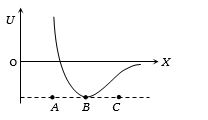
The potential energy $U$ between two molecules as a function of the distance $X$ between them has been shown in the figure. The two molecules are
A shell is fired vertically upwards with a velocity $v_1$ from a trolley moving horizontally with velocity $v_2$. A person on the ground observes the motion of the shell as a parabola, whose horizontal range is ....
The work done by the external forces on a system equals the change in:
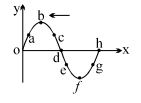
The figure represents the instantaneous picture of a transverse harmonic wave traveling along the negative $x$-axis. Choose the correct alternative $(s)$ related to the movement of the nine points shown in the figure.  The points moving with maximum velocity is/are
A particle moves along a circle if radius $\frac{{20}}{\pi }\;m$ with constant tangential acceleration. If the velocity of the particle is $80\;m/s$ at the end of the second revolution after motion has begun the tangential acceleration is
A normal eye is not able to see objects closer than 25cm because:
The property of a body by virtue of which it tends to regain its original size and shape of a body when applied force is removed, is known as:
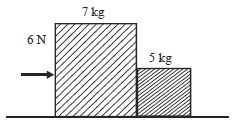
Two block of masses $7\, kg$ and $5\, kg$ are placed in contact with each other on a smooth surface. If a force of $6\, N$ is applied on the heavier mass, the force on the lighter mass is ............ $N$
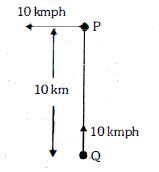
There are two particles $P$ and $Q$ separated by distance $10\ km$ and moving with velocities $10\ kmph$ as shown on a smooth horizontal surface. The time elapsed before they come at minimum separation is.........$hr$
A solid sphere, a hollow sphere and a disc, all having same mass and radius, are placed at the top of a smooth incline and released. Least time will be taken in reaching the bottom by: