MCQ
The work done by the external forces on a system equals the change in:
  • Total energy.
  • B
    Kinetic energy.
  • C
    Potential energy.
  • D
    None of these.

Answer

Correct option: A.
Total energy.
When work is done by an external forces on a system, the total energy of the system will change.

Need a full question paper?

Generate a complete, print-ready paper with questions like this in minutes — across 16+ boards, with answer keys.

Start Generating Free

Similar questions

A particle is situated at the origin of a coordinate system. The following forces begin to act on the particle simultaneously (Assuming particle is initially at rest)

${\vec F_1} = 5\hat i - 5\hat j + 5\hat k$            ${\vec F_2} = 2\hat i + 8\hat j + 6\hat k$

${\vec F_3} =  - 6\hat i + 4\hat j - 7\hat k$         ${\vec F_4} =  - \hat i - 3\hat j - 2\hat k$

Then the particle will move
The pressure of a gas kept in an isothermal container is 200kPa. If half the gas is removed from it, the pressure will be:
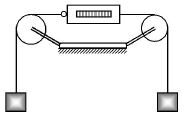
In the arrangement shown, the pulleys are fixed and ideal, the strings are light, $m_1 > m_2$ and $S$ is a spring balance which is itself massless. The reading of $S$ (in units of mass) is
A source of sound is moving with constant velocity of $20\, m/s$ emitting a note of frequency $1000 \,Hz.$ The ratio of frequencies observed by a stationary observer while the source is approaching him and after it crosses him will be

(Speed of sound $v = 340\, m/s$)

During which of the following thermodynamic process represented by $P V$ diagram the heat energy absorbed by system may be equal to area under $P V$ graph?
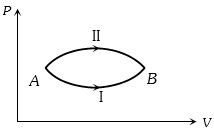
A system goes from $A$ to $B$ via two processes $I$ and $II$ as shown in figure. If $\Delta {U_1}$ and $\Delta {U_2}$ are the changes in internal energies in the processes $I$ and $II$ respectively, then
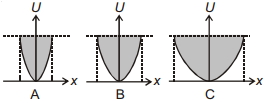
The variations of potential energy $(U)$ with position $x$ for three simple harmonic oscillators $A, B$ and $C$ are shown in figure. The oscillators have same mass. The time period of oscillation is greatest for
A solid cylinder $P$ rolls without slipping from rest down an inclined plane attaining a speed $v_p$ at the bottom. Another smooth solid cylinder $Q$ of same mass and dimensions slides without friction from rest down the inclined plane attaining a speed $v_q$ at the bottom. The ratio of the speeds $\frac{v_q}{v_p}$ is
A silver ingot weighing $2.1 kg$  is held by a string so as to be completely immersed in a liquid of relative density $0.8$. The relative density of silver is $10.5$ . The tension in the string in $kg-wt$ is
A solid sphere of radius $R$ and density $\rho$ is attached to one end of a mass-less spring of force constant $k$. The other end of the spring is connected to another solid sphere of radius $R$ and density $3 p$. The complete arrangement is placed in a liquid of density $2 p$ and is allowed to reach equilibrium. The correct statement$(s)$ is (are)

$(A)$ the net elongation of the spring is $\frac{4 \pi R^3 \rho g}{3 k}$

$(B)$ the net elongation of the spring is $\frac{8 \pi R^3 \rho g}{3 k}$

$(C)$ the light sphere is partially submerged.

$(D)$ the light sphere is completely submerged.