Question
Answer the following questions:
  1. Define electric flux. Write its SI unit.
  2. Using Gauss’s law, prove that the electric field at a point due to a uniformly charged infinite plane sheet is independent of the distance from it.
  3. How is the field directed if:
  • The sheet is positively charged.
  • Negatively charged?

Answer

  1. Electric flux: It is defined as the total number of electric field lines passing through an area normal to its surface.
$\Phi=\oint\vec{\text{E}}.\vec{\text{dS}}$

The SI unit is $Nm^2/ C$ or volt-metre.
  1. Image
Let electric charge be uniformly distributed over the surface of a thin, non-conducting infinite sheet. Let the surface charge density (i.e., charge per unit surface area) be σ. We need to calculate the electric field strength at any point distant r from the sheet of charge.

To calculate the electric field strength near the sheet, we now consider a cylindrical Gaussian surface bounded by two plane faces A and B lying on the opposite sides and parallel to the charged sheet and the cylindrical surface perpendicular to the sheet (fig). By symmetry the electric field strength at every point on the flat surface is the same and its direction is normal outwards at the points on the two plane surfaces and parallel to the curved surface.

Total electric flux,

or $\oint\limits_\text{S}\vec{\text{E}}.\vec{\text{dS}}=\oint\limits_{\text{S}_1}\vec{\text{E}}.\vec{\text{dS}_1}+\oint\limits_{\text{S}_2}\vec{\text{E}}.\vec{\text{dS}_2}+\oint\limits_{\text{S}_3}\vec{\text{E}}.\vec{\text{dS}_3}$

$\oint\limits_\text{S}\vec{\text{E}}.\vec{\text{dS}}=\oint\limits_{\text{S}_1}\text{E dS}_1\cos0^\circ+\oint\limits_{\text{S}_2}\text{E dS}_2\cos0^\circ+\oint\limits_{\text{S}_3}\text{E dS}_3\cos90^\circ$

$=\text{E}\oint\text{dS}_1+\text{E}\oint\text{dS}_2=\text{Ea}+\text{Ea}=2\text{Ea}$

$\therefore$ Total electric flux = 2Ea

As $\sigma$ is charge per unit area of sheet and a is the intersecting area, the charge enclosed by Gaussian surface $=\sigma\text{a}$

Total electric flux $=\frac{1}{\in_0}\times$ (total charge enclosed by the surface)

i.e., $2\text{Ea}=\frac{1}{\in_0}(\sigma\text{a})$

$\therefore\ \text{E}=\frac{\text{p}}{2\in_0}.$

Thus electric field strength due to an infinite flat sheet of charge is independent of the distance of the point.
  1.  
  • If $\sigma$ is positive, $\vec{\text{E}}$ points normally outwards/ away from the sheet.
  • If $\sigma$ is negative, $\vec{\text{E}}$ points normally inwards/ towards the sheet.

Need a full question paper?

Generate a complete, print-ready paper with questions like this in minutes — across 16+ boards, with answer keys.

Start Generating Free

Similar questions

Two long, straight wires, each carrying a current of 5A, are placed along the X and Y-axes respectively. The currents point along the positive directions of the axes. Find the magnetic fields at the points $(a) (1m, 1m), (b) (-1m, 1m), (c) (-1m,-1m)$ and $(d) (1m, -1m),$
Consider the situation of the previous problem:
  1. Find the tension in the string in equilibrium.
  2. Suppose the ball is slightly pushed aside and released. Find the time period of the small oscillations.
Total charge -Q is uniformly spread along length of a ring of radius R. A. small test charge +q of mass m is kept at the centre of the ring and is given a gentle push along the axis of the ring.
  1. Show that the particle executes a simple harmonic oscillation.
  2. Obtain its time period.
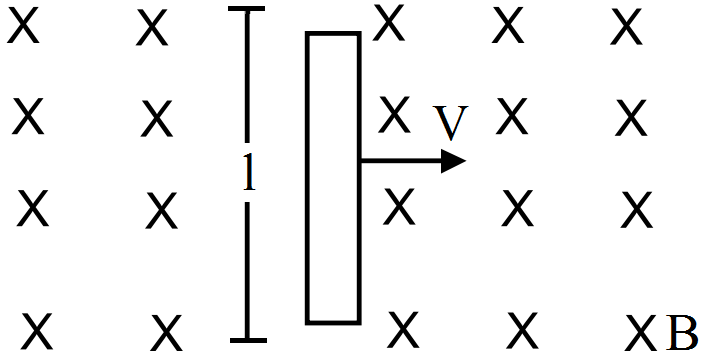
A conducting wire of length l, lying normal to a magnetic field B, moves with a velocity v, as shown in the figure.
  1. Find the average magnetic force on a free electron of the wire.
  2. Due to this magnetic force, electrons concentrate at one end, resulting in an electric field inside the wire. The redistribution stops when the electric force on the free electrons balances the magnetic force. Find the electric field developed inside the wire when the redistribution stops.
  3. What potential difference is developed between the ends of the wire?
Figure shows a smooth track which consists of a straight inclined part of length 1 joining smoothly with the circular part. A particle of mass m is projected up the incline from its bottom.
  1. Find the minimum projection-speed $v_0$, for which the particle reaches the top of the track.
  2. Assuming that the projection-speed is $2v_0 $ and that the block does not lose contact with the track before reaching its top, find the force acting on it when it reaches the top.
  3. Assuming that the projection-speed is only slightly greater than $v_0$, where will the block lose contact with the track?
A hydrogen atom moving at speed υ collides with another hydrogen atom kept at rest. Find the minimum value of υ for which one of the atoms may get ionized. The mass of a hydrogen atom $= 1.67 \times 10^{-27}kg.$
Consider a circular current-carrying loop of radius R in the x-y plane with centre at origin. Consider the line intergral $\Im(\text{L})=\begin{vmatrix}\int\limits_{-\text{L}}^{\text{L}}\text{B.dl} \end{vmatrix}$ taken along z-axis.
  1. Show that $\Im(\text{L})$ monotonically increases with L.
  2. Use an appropriate Amperian loop to show that $\Im(\infty)=\mu_0\text{I}$, where I is the current in the wire.
  3. Verify directly the above result.
  4. Suppose we replace the circular coil by a square coil of sides R carrying the same current I. What can you say about $\Im(\text{L})$ and $\Im(\infty)$?
Two particles A and B having charges q and 2q respectively are placed on a smooth table with a separation d. A third particle C is to be clamped on the table in such a way that the particles A and B remain at rest on the table under electrical forces. What should be the charge on C and where should it be clamped?
How would you set up a circuit to obtain NOT gate using a transistor?
$i.$ Draw a ray diagram showing the image formation by a compound microscope. Hence obtain the expression for total magnification when the image is formed at least distance of distinct vision.
$iii.$ A compound microscope consists of an objective lens of focal length $2.0 \ cm$ and an eyepiece of focal length $6.0 \ cm$. If they are separated by a distance of $24 \ cm$, find the total magnification when the image is formed at infinity.