Question
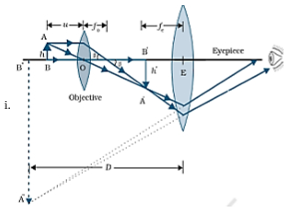
$i.$ Draw a ray diagram showing the image formation by a compound microscope. Hence obtain the expression for total magnification when the image is formed at least distance of distinct vision.
$iii.$ A compound microscope consists of an objective lens of focal length $2.0 \ cm$ and an eyepiece of focal length $6.0 \ cm$. If they are separated by a distance of $24 \ cm$, find the total magnification when the image is formed at infinity.
Answer

Image

Magnification due to objective
$m_0=\frac{h^{\prime}}{h}=\frac{L}{f_0}\left(\because \tan \beta=\frac{h}{f_0}=\frac{h}{L}\right)$
Magnification due to eye piece when final image is formed at the near point
$m _{ e }=1+\frac{D}{f_{ e }}$
Total magnification
$ m = m _0 m_{ e }$
$m =\frac{L}{f_0}\left(1+\frac{D}{f_{ e }}\right)$
$ii.\ m=\frac{L D}{f_o f_e}$
$m=\frac{24 \times 25}{2 \times 6}=\frac{600}{12}=50$
Hence, the total magnification when the image is formed at infinity is $50.$

Need a full question paper?

Generate a complete, print-ready paper with questions like this in minutes — across 16+ boards, with answer keys.

Start Generating Free

Similar questions

The internal energy of a gas is given by U = 1.5PV. It expands from $100cm^3$ to $200cm^3$ against a constant pressure of $1.0 x 10^5$ Pa. Calculate the heat absorbed by the gas in the process.
In a certain region of space, electric field is along the z-direction throughout. The magnitude of electric field is, however, not constant but increases uniformly along the positive z-direction, at the rate of $10^5$ $NC^{-1}$ per metre. What are the force and torque experienced by a system having a total dipole moment equal to $10^{-7}$ Cm in the negative z-direction?
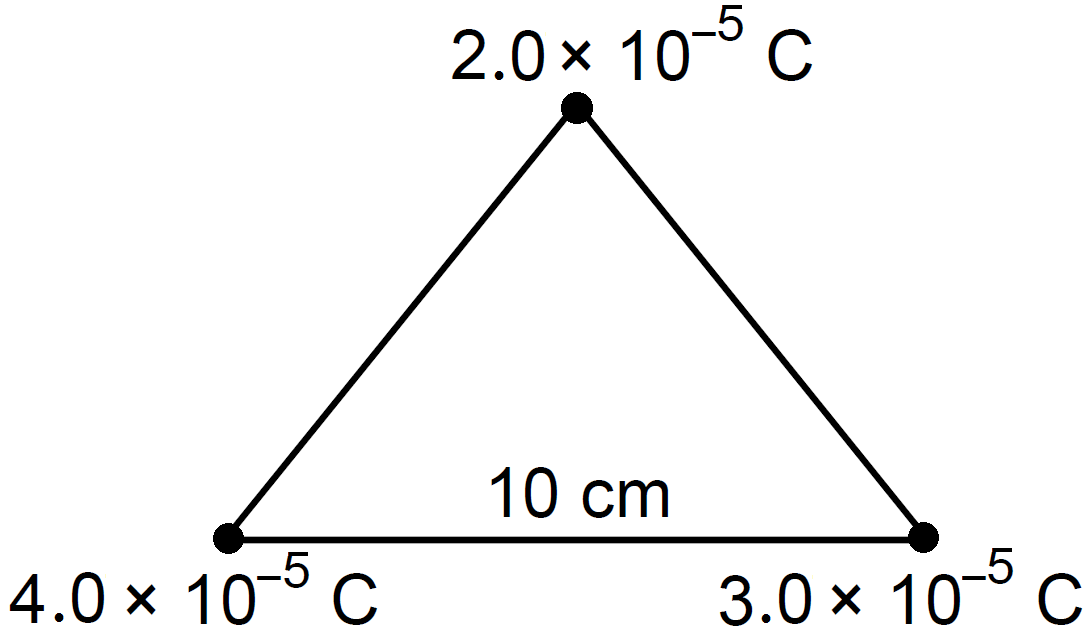
How much work has to be done in assembling three charged particles at the vertices of an equilateral triangle as shown in figure?
Consider a circular ring of radius r, uniformly charged with linear charge density $\lambda.$ Find the electric potential at a point on the axis at a distance x from the centre of the ring. Using this expression for the potential, find the electric field at this point.
An object is placed at a distance of 30cm from a converging lens of focal length 15cm. A normal eye (near point 25cm, far point infinity) is placed close to the lens on the other side.
  1. Can the eye see the object clearly?
  2. What should be the minimum separation between the lens and the eye so that the eye can clearly see the object?
  3. Can a diverging lens, placed in contact with the converging lens, help in seeing the object clearly when the eye is close to the lens?
How many time constants will elapse before the energy stored in the capacitor reaches half of its equilibrium value in a charging RC circuit?
Find the current through the $10\Omega$ resistor shown in figure.
Give the shape of interference fringes observed
a. in a Young's double-slit experiment
b. in the air wedge experiment
c. in the Lloyd's mirror experiment
d. when a small lamp is placed before a thin mica sheet and light waves reflected from the front and back surfaces of the sheet combine to produce interference pattern on a screen behind the lamp. (Pohl's experiment)
e. from a thin air film formed by placing a convex lens on top of a flat glass plate (Newton's arrangement).
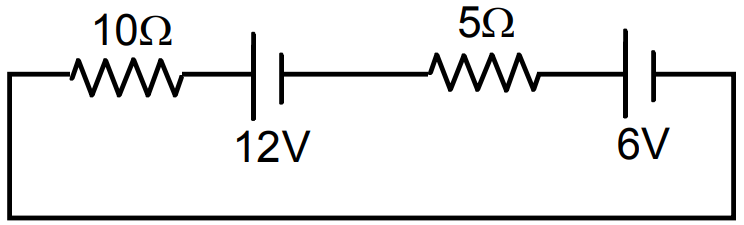
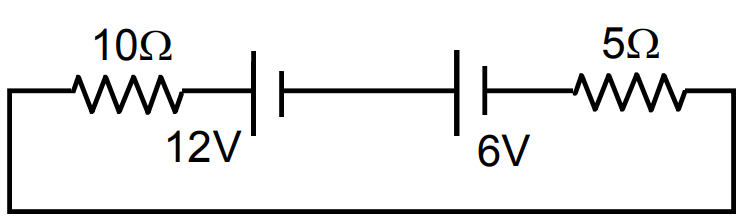
Consider the circuit shown in the figure. Find (a) the current in the circuit (b) the potential drop across the $5\Omega$ resistor (c) the potential drop across the $10\Omega$ resistor. (d) Answer the parts (a), (b) and (c) with reference to the figure.

Figure shows two long coaxial solenoids, each of length ‘L’. The outer solenoid has an area of cross-section $A_1$ and number of turns/ length $n_1$ The corresponding values for the inner solenoid are $A_2$ and $n_2$ Write the expression for self-inductance $L_1, L_2$ of the two coils and their mutual inductance M. Hence show that $\text{M} < \sqrt{\text{L}_2\text{L}_2}.$