Question
Answer the following questions:
Explain how recombinants and non-recombinants are differentiated on the basis of colour production in the presence of a chromogenic substrate. Name that procedure.
Answer

The procedure is called insertional inactivation.
In this method recombinants and non-recombinants are differentiated on the basis of the ability to produce colour in the presence of a chromosomic substrate. In this method, a rDNA is inserted in an enzyme- $\beta-$galactosidase which leads to inactivation of the enzyme which does not produce colour due to insertion.

Need a full question paper?

Generate a complete, print-ready paper with questions like this in minutes — across 16+ boards, with answer keys.

Start Generating Free

Similar questions

  1. Draw a labelled diagrammatic view of human male reproductive system.
  2. Differentiate between:
  • Vas deferens and Vasa efferentia.
  • Spermatogenesis and spermiogenesis.
Describe Miller and Urey’s experiment, along with the product obtained. What is the significance of this experiment?
What are the reasons for biodiversity conservation?
Give the term/ reason:
Why does zona pellucida layer block the entry of additional sperms?
Arun visited his grandfather's farm and noticed that one of the workers was introducing earthworms in the soil. He quickly rushed to his grandfather and asked him the reason. His grandfather explained him the advantages of earthworm in soil improvement.
  1. Why are earthworms also known as detritivores?
  2. Explain fragmentation.
  3. Name the steps in the process of decomposition.
  4. What values are shown by Arun?
Define aneuploidy. How is it different from polyploidy? Describe the individuals having following chromosomal abnormalities.
  1. Trisomy of 21st Chromosome.
  2. XXY.
  3. XO.
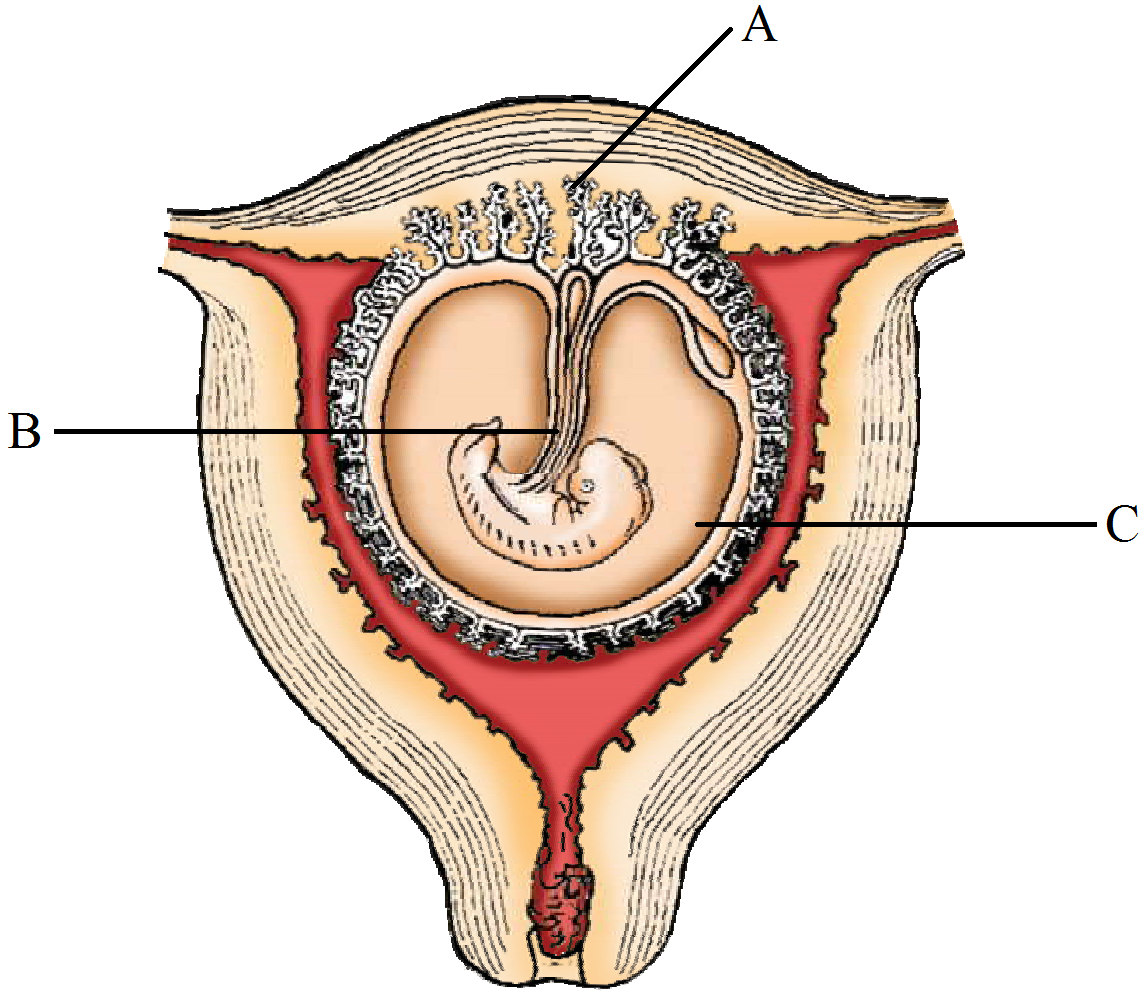
  1. Identify the parts labelled A, B and C in the diagram given.

  1. Draw a labelled diagram of a human blastocyst.
  2. What is parturition and is it induced at the end of pregnancy in a human female?
A pea plant bearing axial flowers is crossed with a pea plant bearing terminal flowers. The cross is carried out to find the genotype of the pea plant bearing axial flowers. Work out the cross to show the conclusions you arrive at.
  1. Explain primary productivity and the factors that influence it.
  2. Describe how do oxygen and chemical composition of detritus control decomposition.
Read the following and answer any four questions from (i) to (v) given below:

Gene therapy is the technique of genetic engineering to replace a faulty gene by a normal healthy functional gene. It is a way of treating genetic disease by introducing a piece of DNA into the cells of an affected individual. Liposomes can be used for gene therapy as they target the cells affected by a genetic disease.

  1. A patient suffers from adenosine deaminase (ADA) deficiency, an autosomal recessive immune deficiency in which bone marrow lymphoblasts cannot replicate to generate immuno-competent lymphocytes. The treatment option that would cure the patient is:
  1. Germ-line gene therapy to replace one ADA gene copy.
  2. Germ-line gene therapy to replace both ADA gene copies.
  3. Somatic cell gene therapy to replace both ADA gene copies in circulating lymphocytes.
  4. Somatic cell gene therapy to replace one ADA gene copy in bone marrow lymphoblasts.
  1. Which type of gene therapy is least effective in transferring DNA to the nucleus?
  1. Adenoviruses.
  2. DNA attached to a ligand.
  3. Liposomes.
  4. Retroviruses.
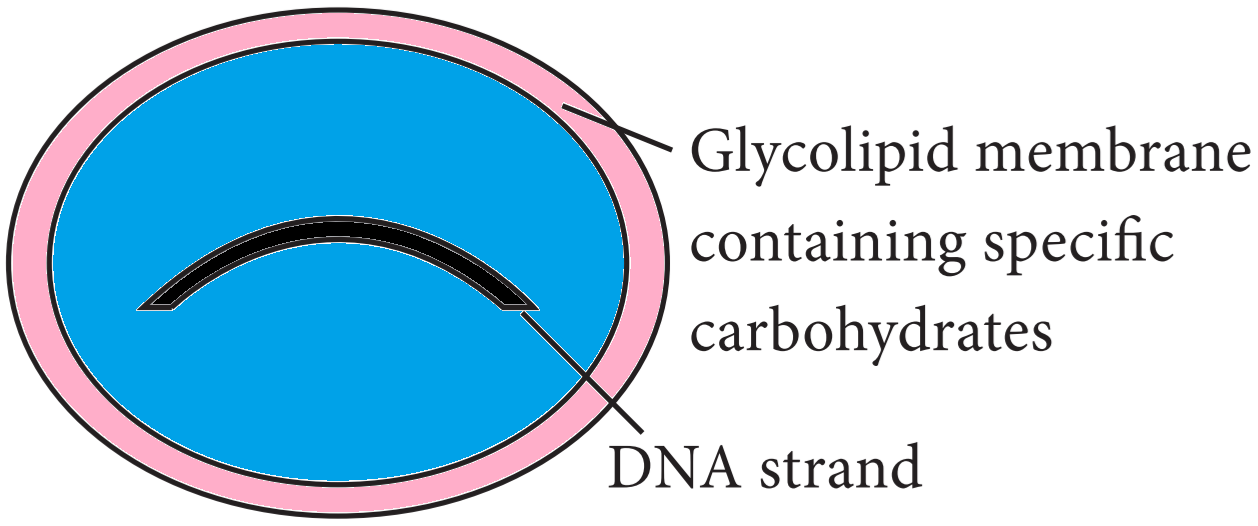
  1. Liposomes can be used for gene therapy as they target the cells affected by a genetic disease. The diagram shows the structure of a liposome.

What feature of a cell surface membrane allows the liposome to target cells affected by a genetic disease? 

  1. Carrier molecules.
  2. Phosphate groups.
  3. Protein channels.
  4. Receptor molecules.
  1. Which of the following disorders would gene therapy be least effective?
  1. Cystic fibrosis.
  2. Huntington's disease.
  3. Sickle cell anaemia.
  4. Type II diabetes.
  1. Following are some reasons explaining why gene therapy is not yet fully an effective treatment for genetic diseases.
  1. Lack of knowledge of DNA sequences.
  2. Lack of efficient and safe gene delivery system.
  3. Cost of the technology.
  4. Some diseases involve multiple genes.
  5. Problems with appropriate gene regulation.

Select the correct option. 

  1. I, III and V only
  2. II, IV and V only
  3. Ill, IV and V only
  4. I, III and IV only