Question
Answer the following questions:
Explain Polygenic inheritance and Multiple allelism with the help of suitable examples.

Answer

Co–dominance:
  • The alleles which are able to express themselves independently, even when present together are called co–dominant alleles and this biological phenomenon is called co–dominance. For example, ABO blood grouping in humans.
  • ABO blood groups are controlled by gene I. Gene I has three alleles $I^A,I^B$ and $I^O/i.$
  • $I^A$ and $I^B$ produce RBC surface antigens sugar polymer A and B, respectively, whereas i does not produce any antigen.
  • IA and IB are dominant over i hence $I^A$ and $I^B$ are dominant alleles and i is recessive allele as in $I^Ai$ and $I^Bi.$ • When IA and IB are present together, both express equally and produce the surface antigens A and B, hence show co–dominance.
  • Since humans are diploid, each person possesses any two of the three ‘I’ gene alleles, resulting into six different genotypic combinations and four phenotypic expressions.
Table showing the genetic basis of blood groups in human population.
Allele from Parent 1
Allele from Parent 2
Genotype of offspring
Blood groups of offspring
$I^A$
$I^A$
$I^AI^A$
A
$I^A$
$I^B$
$I^AI^B$
AB
$I^A$
i
$I^Ai$
A
$I^B$
$I^B$
$I^BI^B$
B
IB
i
IBi
B
i
i
ii
O
Polygenic Inheritance:
  • It is a type of inheritance, in which traits are controlled by three or more genes. Such traits are called polygenic traits.
  • The phenotype reflects contribution of each allele and is also influenced by the environment.
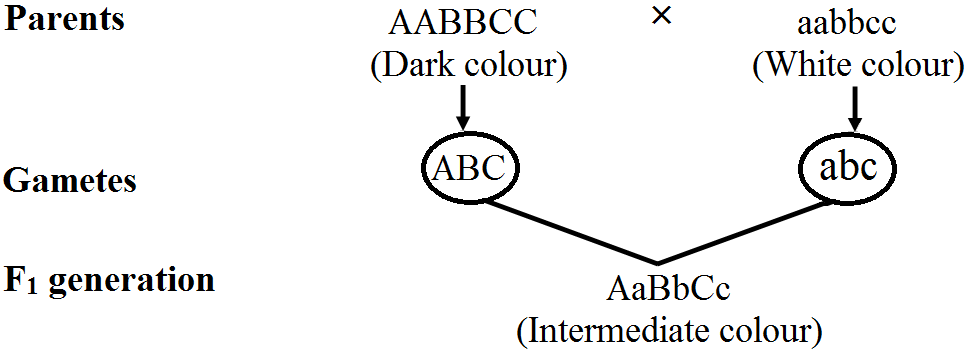
  • For example, human skin colour. Suppose three genes A, B and C control skin colour with A, B, C being the dominant alleles and a, b, c being the recessive alleles. Then,
  • The $F_2$ generation will have varied skin tones, with each type of allele in the genotype determining the darkness or lightness of the skin.

Need a full question paper?

Generate a complete, print-ready paper with questions like this in minutes — across 16+ boards, with answer keys.

Start Generating Free

Similar questions

Following is the sequence of nucleotide in two strands of DNA. Observe the strands and answer the preceding questions.
5' - GAATTC - 3'
3' - CTTAAG - 5'
  1. Name the special term used for such an arrangement of nucleotide.
  2. Name the special type of enzymes which work/ function at this specific points.
  3. Name the enzyme, that cut DNA between GA sequence.
  4. Name the single strands produced after the action of the enzyme.
a. Explain the process of syngamy and triple fusion in angiosperms.
b. Trace the development of the product of syngamy upto its mature stage in a dicot plant.
c. Draw and label three important parts of a mature dicot embryo.
Answer the following questions:
Explain the hormonal regulation of the process of spermatogenesis in humans.
Describe the beneficial activities of bacteria. ###How can we say that bacteria are our friends? Explain.
Describe the process of decomposition of detritus under the following heads: Fragmentation; leaching; catabolism; humification andmineralisation.
Discuss the various types of positive interactions between species.
  1. Describe the characteristics a cloning vector must possess.
  2. Why DNA cannot pass through the cell membrane? Explain. How is a bacterial cell made ‘competent’ to take up recombinant DNA from the medium?
A tall pea plant with yellow seeds (heterozygous for both the traits) is crossed with a dwarf pea plant with green seeds. Using a Punnett square work out the cross to show the phenotypes and the genotypes of $F_1$ generation.
Draw a labelled diagram of the sectional view of a mature pollen grain in angiosperms. Explain the functions of its different parts.
Which type of food would have lactic acid bacteria. Discuss their useful application.