Question
Discuss the various types of positive interactions between species.

Answer

Following are the positive interactions between species:
  1. Mutualism: This is a relationship between two organisms in which both the organisms are benefitted. Lichen is a very good example of mutualism. Lichen is an association of fungi and algae. The fungal part attaches to the substratum and gets water and minerals for the algal part. The algal part carries out photosynthesis and provides food to the fungal part.
  2. Commensalism: This is a relationship between two organisms in which one organism is benefitted, while another organism is neither at gain nor at loss. Egrets keep on sitting on the back of herbivore animals; like buffalo, cow, etc. when the cattle forage for grass, the insects under the grass fly away haphazardly. This gives a chance to the egrets to feed on insects.

Need a full question paper?

Generate a complete, print-ready paper with questions like this in minutes — across 16+ boards, with answer keys.
Start Generating Free

Similar questions

Describe in detail the development of female gametophyte in angiosperm with well labelled diagram.###Explain in the process of Megasporogenesis in a typical angiosperm plant by drawing the well labelled diagram of mature embryo sac.
A flower of brinjal plant following the process of sexual reproduction produces 360 viable seeds.
Answer the following questions giving reasons:
How many microspore mother cells must have undergone reduction division prior to dehiscence of another in the above case?
Do all the gametes formed from a parent organism have the same genetic composition? Analyse the situation with the background of gametogenesis and provide suitable explanation.
Highlights the reproductive health issues and strategies.
Describe the human male reproductive system.
Which of the following ecosystems will be more productive in terms of primary productivity? Justify your answer.
A young forest, a natural old forest, a shallow polluted lake, alpine meadow.
Recombinant DNA (rDNA) is a technology that uses enzymes to cut and paste together DNA sequences of interest. The recombined DNA sequences can be placed into vehicles called vectors that ferry the DNA into a suitable host cell where it can be copied or expressed.
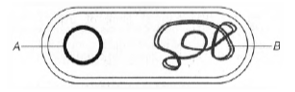
i. A bacterial cell is shown in the figure given below. Label the part 'A' and 'B'. Also, mention the use of part A in rDNA technology.
Image
ii. Suppose a linear DNA fragment and a plasmid has three restriction sites for EcoRI. How many fragments will be produced from linear DNA and plasmid, respectively?
What is floriculture? Describe the structure of a stamen. Also draw a well labelled diagram of a typical stamen.
Rose plants produce large, attractive bisexual flowers but they seldom produce fruit. On the other hand, Lady’s finger produces plenty of fruits. Analyse the reasons for failure of fruit formation in rose.
Discuss the following:Radioactive wastes.