Question
Answer the following questions:
How did Morgan show the deviation in inheritance pattern in Drosophila with respect to this law?
Answer

Linkage and Recombination:
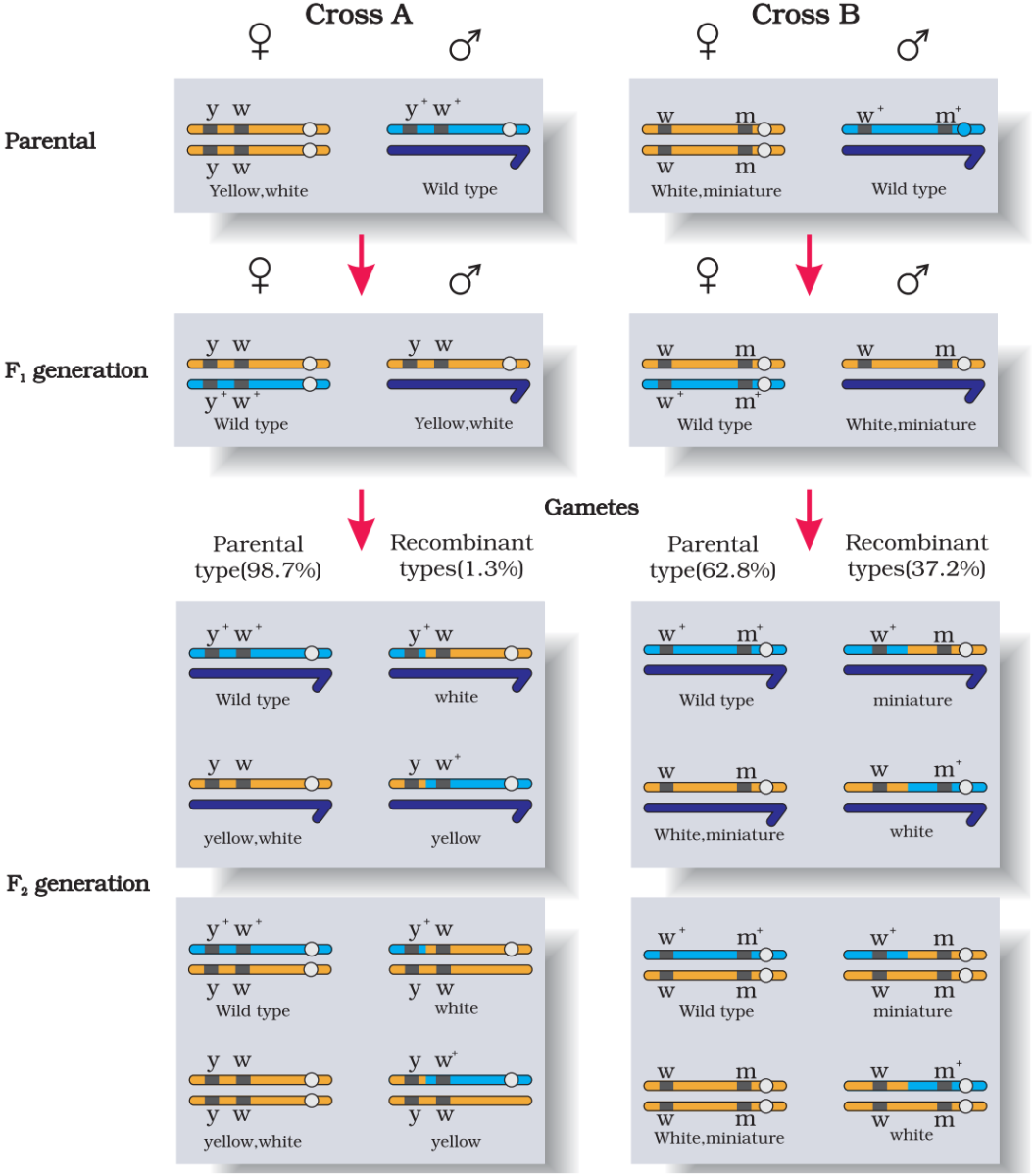
  • T. H. Morgan carried out several dihybrid crosses in Drosophila to study the genes that are sex–linked. He observed that when the two genes in a dihybrid cross are located on the same chromosome, the proportion of parental gene combinations in the progeny was much higher than the non-parental or recombination of genes.
  • Morgan and his group found that when genes are grouped on the same chromosome, some genes are tightly linked or associated and show little recombination.
  • Linkage: Results of two dihybrid crosses conducted by Morgan. Cross A shows crossing between genes y and w; Cross B shows crossing between genes w and m. Here dominant wild type alleles are represented with (+) sign in superscript.
  • When the genes are loosely linked they show higher percentage of recombination.
  • Morgan hybridised yellow bodied and white eyed females with brown bodied and red eyed males (wild type) (cross–A) and inter–crossed their $F_1$ progeny.
  • Alfred Sturtevant determined that genes of Drosophila are arranged in a linear order. He measured the distance between genes and prepared chromosome maps with the position of genes on the chromosomes based on percentage of recombinants. These are also called genetic maps.

Need a full question paper?

Generate a complete, print-ready paper with questions like this in minutes — across 16+ boards, with answer keys.
Start Generating Free

Similar questions

  1. Explain the differences and similarities between hydrarch and xerarch successions of plants.
  2. Mention the role of living organisms in the phosphorus cycle.
Draw a diagram and describe the immune system found in humans.
Starting with the zygote, draw the diagrams of the different stages of embryo development in a dicot.
Answer the following questions:
Explain the role of pituitary and the ovarian hormones in menstrual cycle in human females.
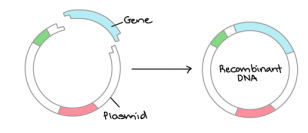
A vector is a way to take a sequence of DNA, usually, and introduce it into another place. So what vectors do is allow you to propagate the DNA you're interested in, in the organism you've chosen to propagate it in. So the simplest one is the origins of recombinant DNA technology: They made copies of RNAs, and they were able to insert these into what is known as plasmids.
Image
Unless the vector and source DNA are cut, fragments separated and joined, the desired recombinant vector molecule cannot be created.
i. How are the desirable DNA sequences cut?
ii. Explain the technique used to separate the cut fragments.
iii. How are the resultant fragments joined to the vector DNA molecule?
a. Draw a diagram of a fully developed embryo sac of an angiosperm. Label its chalazal end and any other five parts within the embryo sac.
b. Why does the development of an endosperm precede that of the embryo in angiosperm?
c. Number of chromosomes in an onion plant cell is 16. Name the cells of the embryo sac having 16 and 24 chromosomes formed after fertilisation.
What is called immunity? How many types are there? Describe innate immunity.
Enumerate the salient features of human genome.
Describe the human male reproductive system.
Define transcription. Write the names of the parts of the transcription unit in DNA. Draw a schematic diagram of the transcription unit.