MCQ
Antinodal curves correspond to _____ interference.
- AConstructive
- BDestructive
- CWhere intensity is less than maximum but not completely zero.
- DNone of these
Explanation:
Antinodal curves correspond to constructive interference.
Generate a complete, print-ready paper with questions like this in minutes — across 16+ boards, with answer keys.
A uniform electric field having a magnitude  and direction along the positive X - axis exists. If the potential V is zero at x = 0, then its value at X = +x will be
|
(a) |
(b) |
(c) |
(d) |
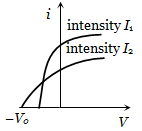
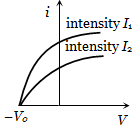
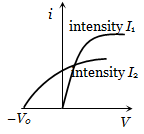
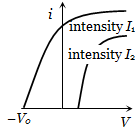
The curves (a), (b) (c) and (d) show the variation between the applied potential difference (V) and the photoelectric current (i), at two different intensities of light (I1 > I2). In which figure is the correct variation shown
|
(a)
|
(b)
|
(c)
|
(d)
|
Effective capacitance between A and B in the figure shown is (all capacitance are in mF)
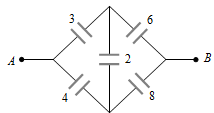
|
(a) 21 mF |
(b) 23 mF |
(c) |
(d) |
Four wires AB, BC, CD, DA of resistance 4 ohm each and a fifth wire BD of resistance 8 ohm are joined to form a rectangle ABCD of which BD is a diagonal. The effective resistance between the points A and B is
|
(a) 24 ohm |
(b) 16 ohm |
(c) |
(d) |
n identical cells each of e.m.f. E and internal resistance r are connected in series. An external resistance R is connected in series to this combination. The current through R is
|
(a) |
(b) |
(c) |
(d) |
The de-Broglie wavelength λ associated with an electron having kinetic energy E is given by the expression
|
(a) |
(b) |
(c) 2mhE |
(d) |