MCQ
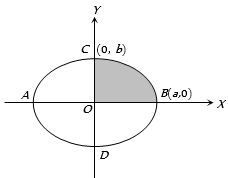
Area of the ellipse $\frac{{{x^2}}}{{{a^2}}} + \frac{{{y^2}}}{{{b^2}}} = 1$ is
  • $\pi \,ab\,\,\, sq. \,unit$
  • B
    $\frac{1}{2}\pi \,ab\,\,\, sq. \,unit$
  • C
    $\frac{1}{4}\pi \,ab\,\,\, sq. \,unit$
  • D
    None of these

Answer

Correct option: A.
$\pi \,ab\,\,\, sq. \,unit$
a
(a) Since the given equation contains only even powers of $x$ and only even powers of $y$,

the curve is symmetrical about $y -$ axis as well as $x - $ axis.

$\therefore$ Whole area of given ellipse

$ = 4({\rm{area\,\, }}\,{\rm{of}}\,BCO) = 4 \times \int_0^a {y\,dx = 4\int_0^a {\frac{b}{a}\sqrt {{a^2} - {x^2}} } dx} $

$ = 4ab\int_0^{\pi /2} {\left( {\frac{{1 + \cos 2\theta }}{2}} \right)\,d\theta } $, {Putting 

$x = a\sin \theta $}

$ = 2ab\left( {\int_0^{\pi /2} {\,\,d\theta + \int_0^{\pi /2} {\,\,\,\cos 2\theta \,d\theta } } } \right)$

$ = [\theta ]_0^{\pi /2} + \left[ {\frac{{\sin 2\theta }}{2}} \right]_0^{\pi /2} = \pi ab\,\,\, sq. \,unit$
Need a full question paper?

Generate a complete, print-ready paper with questions like this in minutes — across 16+ boards, with answer keys.

Start Generating Free

Similar questions

The solution of differential equation $(\text{e}^\text{y}+1)\cos\text{dx}+\text{e}^\text{y}\sin\text{x}\text{dy}=0$ is:
  1. $\text{e}^\text{y}+1\sin\text{x}=\text{c}$
  2. $\text{e}^\text{y}\sin=\text{c}$
  3. $(\text{e}^\text{y}+1)\cos\text{x}=\text{c}$
  4. $\text{None of these}$
The altitude of a cone is 20cm and its semi-vertical angle is 30°. If the semi-vertical angle is increasing at the rate of 2° per second, then the radius of the base is increasing at the rate of:
  1. $30\text{cm}/\text{sec}.$
  2. $\frac{160}{3}\text{cm}/\text{sec}.$
  3. $10\text{cm}/\text{sec}.$
  4. $160\text{cm}/\text{sec}.$
Differential coefficient of ${{{{\tan }^{ - 1}}x} \over {1 + {{\tan }^{ - 1}}x}}$ w.r.t. ${\tan ^{ - 1}}x$ is
The solution of the differential equation dy = (1 + y2) dx is:
  1. $\text{y}=\tan\text{x}+\text{c}$
  2. $\text{y}=\tan(\text{x}+\text{c})$
  3. $\tan^{-1}(\text{y}+\text{c})=\text{x}$
  4. $(\tan^{-1}(\text{y}+\text{c})=2\text{x}$
If $y = {e^x}\log x$, then ${{dy} \over {dx}}$ is
Let $\vec{a}$ and $\vec{b}$ be two vectors such that $|\vec{a}+\vec{b}|^{2}=|\vec{a}|^{2}+2|\vec{b}|^{2}, \vec{a} \cdot \vec{b}=3 \quad$ and $\quad|\vec{a} \times \vec{b}|^{2}=75$.Then $|\vec{a}|^{2}$ is equal to $.......$
Let $\alpha \in(0,1)$ and $\beta=\log _{ c }(1-\alpha)$. Let $P_n(x)=x+\frac{x^2}{2}+\frac{x^3}{3}+\ldots . .+\frac{x^n}{n}, x \in(0,1)$ Then the integral $\int \limits_0^\alpha \frac{ t ^{50}}{1- t } dt$ is equal to
The projection of the vector $i+j+k$ along the vector $j$ is
Which of the following function $(s)$ not defined at $x = 0$ has/have irremovable discontinuity at $x = 0$ ?
The set of points of discontinuity of the function $f(x)$ = $\frac{{\tan \,x.{{\tan }^{ - 1}}\left( {\frac{1}{{x - 1}}} \right)}}{{x\left( {x - 3} \right)\left( {x - 5} \right)}}$ is